2026
Nearbuy
A microservices platform where users grab limited flash-sale vouchers from local shops, built in Go with gRPC, an API gateway, and a separate PostgreSQL database for each service. Atomic Redis Lua scripts prevent overselling during high traffic, and Kafka with DTM Saga distributed transactions handles orders reliably across services. Includes Redis rate limiting, caching and session login, deployed on Kubernetes using Tilt.
- Go
- gRPC
- Kafka
- Postgres
- Redis
- React
- Kubernetes
🌟 Key Features
- Microservices with gRPC & Database per Service
- Event-Driven Architecture with Kafka
- Distributed Transactions with DTM Saga & Barrier
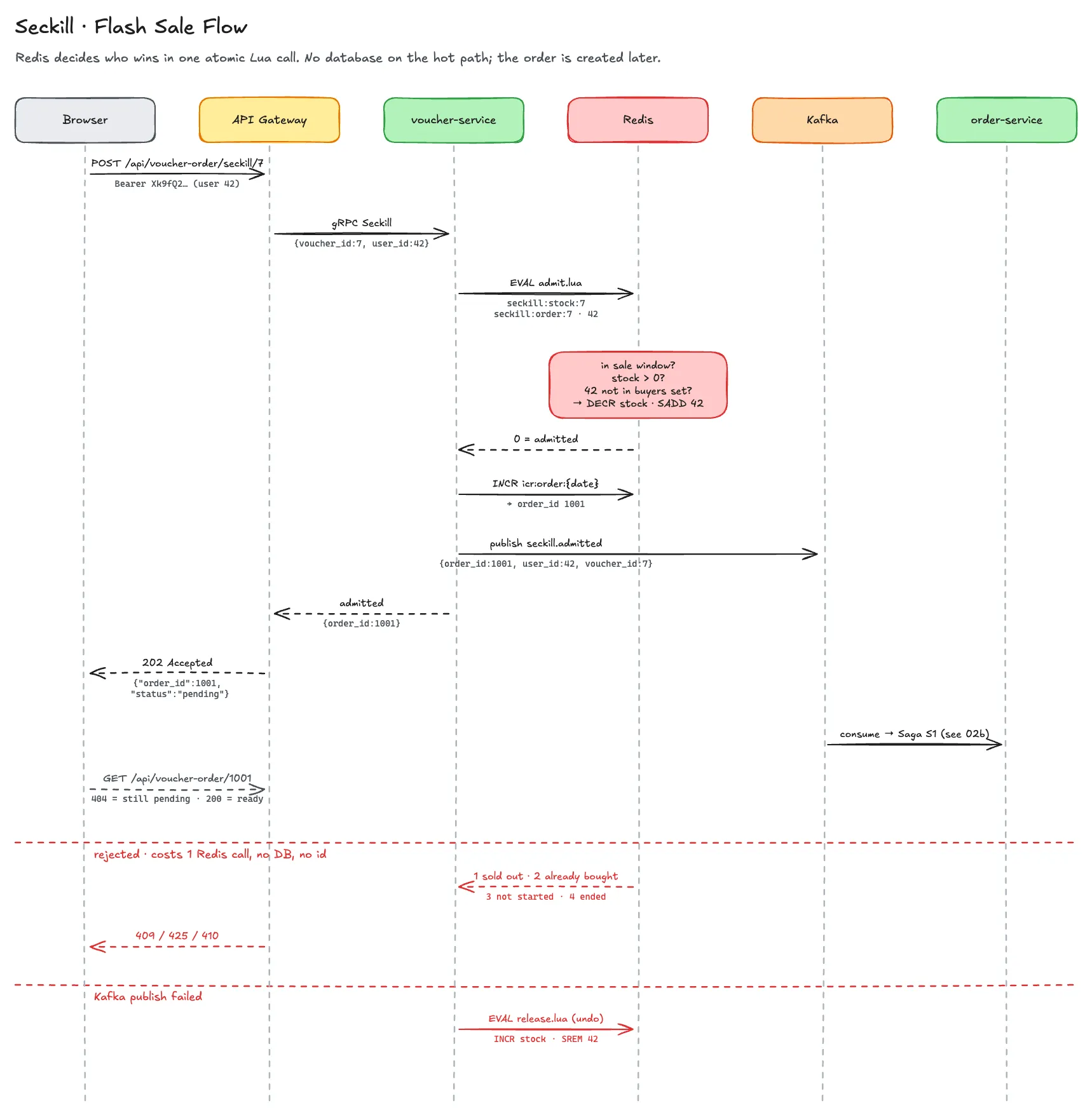
- Flash Sale with Redis Lua & Async Order Creation
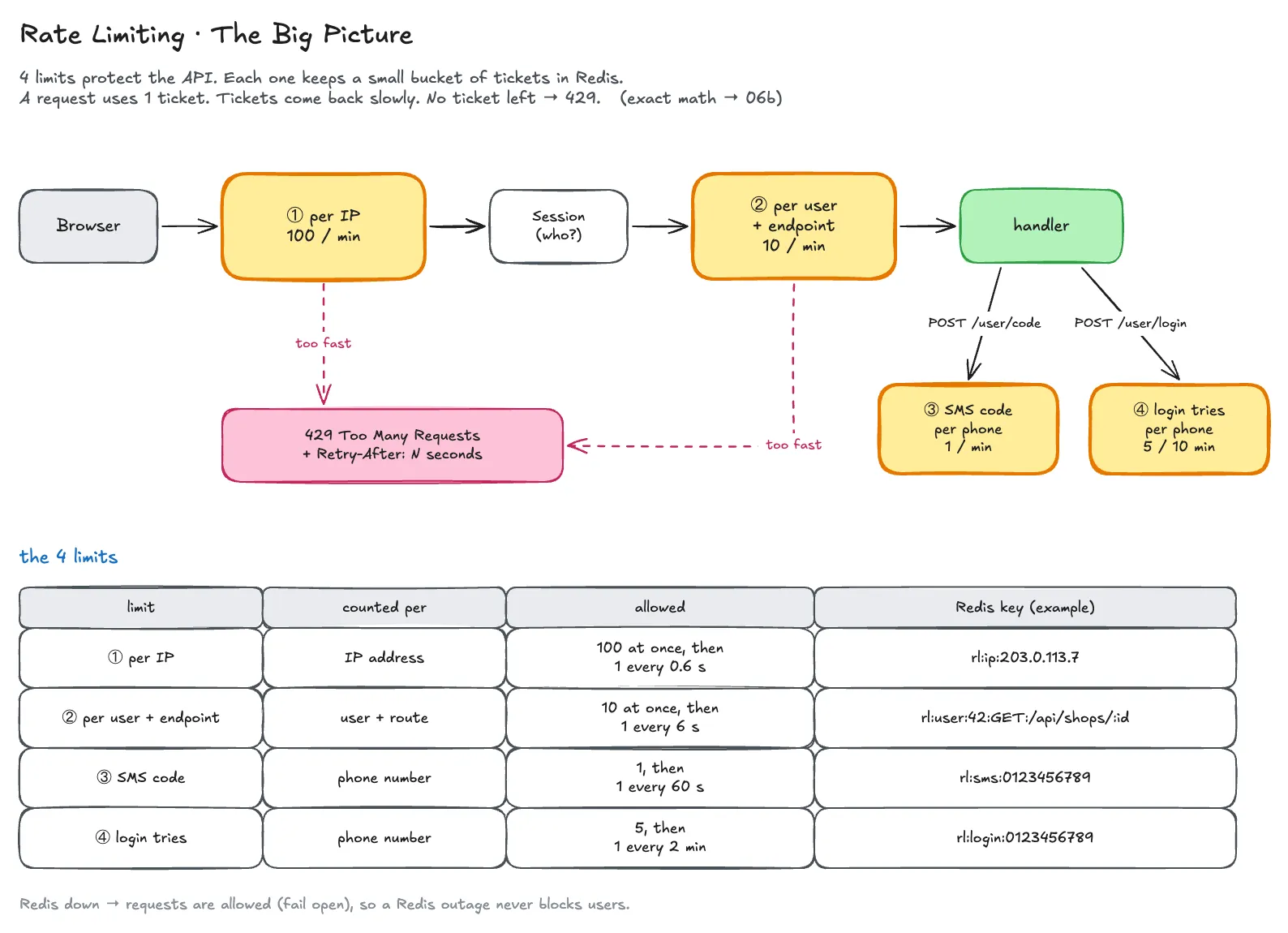
- Rate Limiting with Token Bucket in Redis
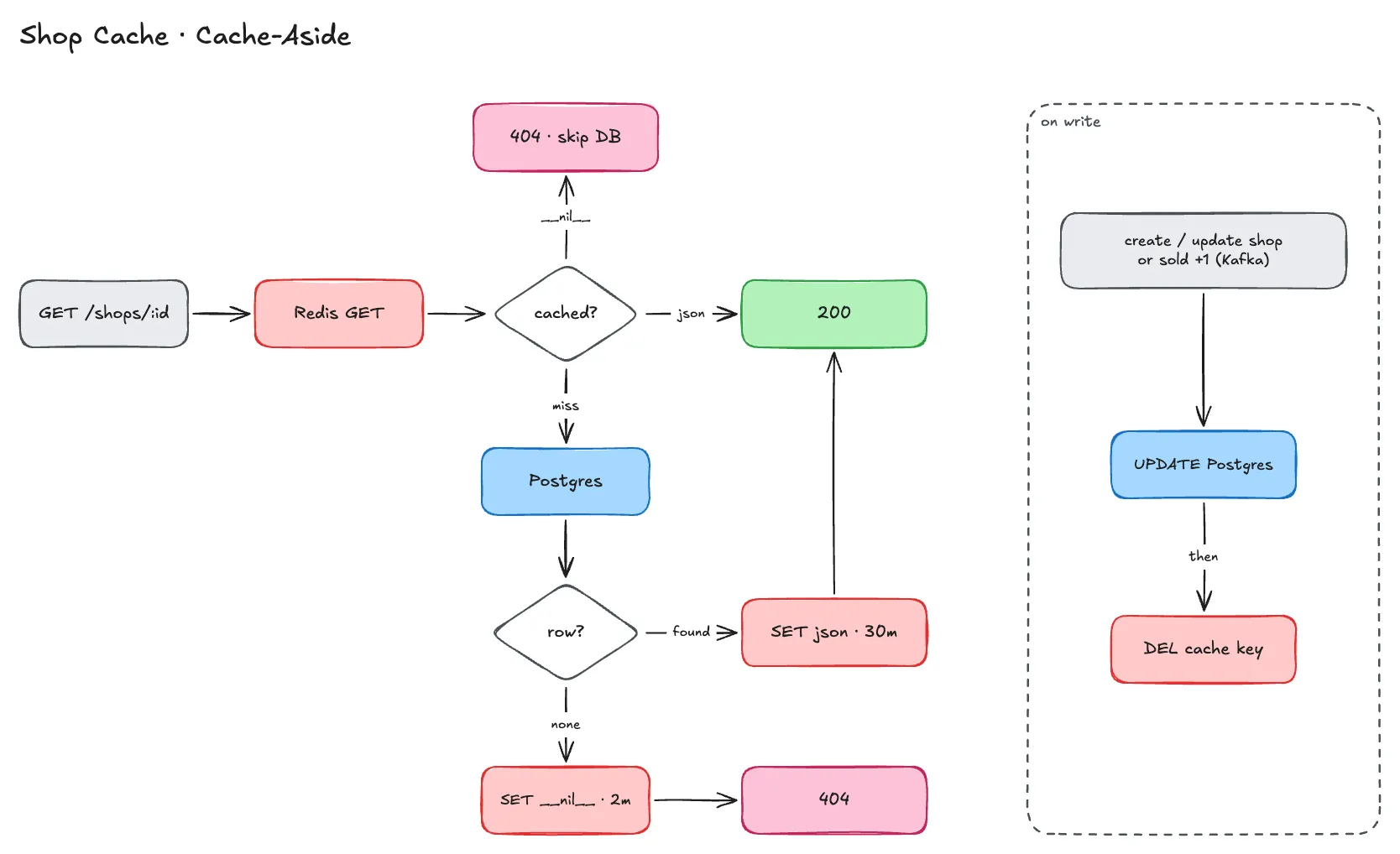
- Redis Cache-Aside with Cache Penetration Protection
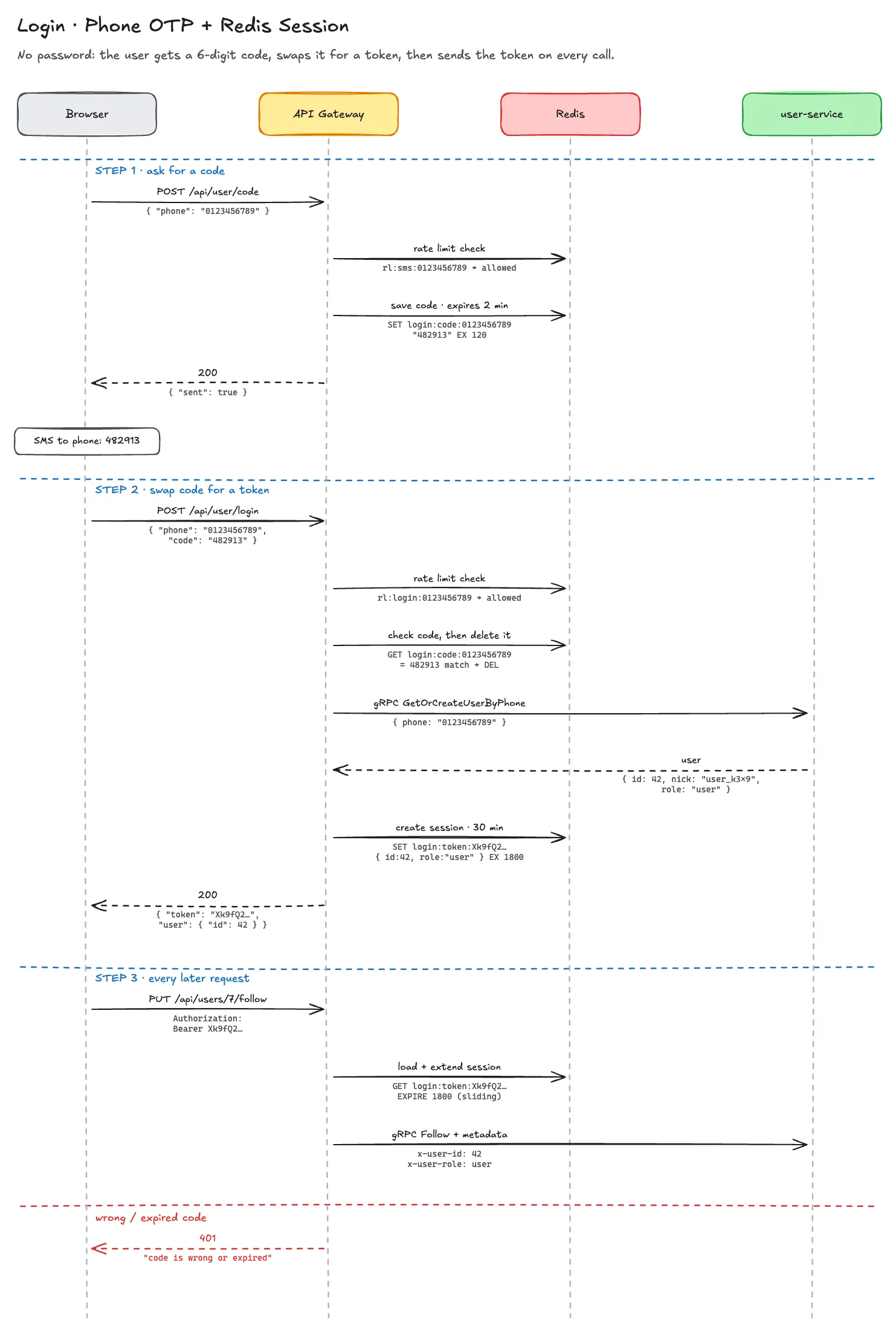
- SMS Login with Redis Session & Role-Based Access
- Order Expiry Job (15 mins)
- Kubernetes Local Setup with kind & Tilt
🛠️ Tools
Backend: Go, Echo v5, gRPC, Protobuf, pgx v5, sqlc, golang-migrate, go-redis v9, kafka-go, DTM, PostgreSQL 18, Redis 8, Kafka 4.1, Docker, Kubernetes, kind, kubectl, ingress-nginx, Tilt
Frontend: React 19, TypeScript, Vite, Material UI, React Router, React Hook Form, Zod, Zustand, Axios, qrcode.react, oxlint
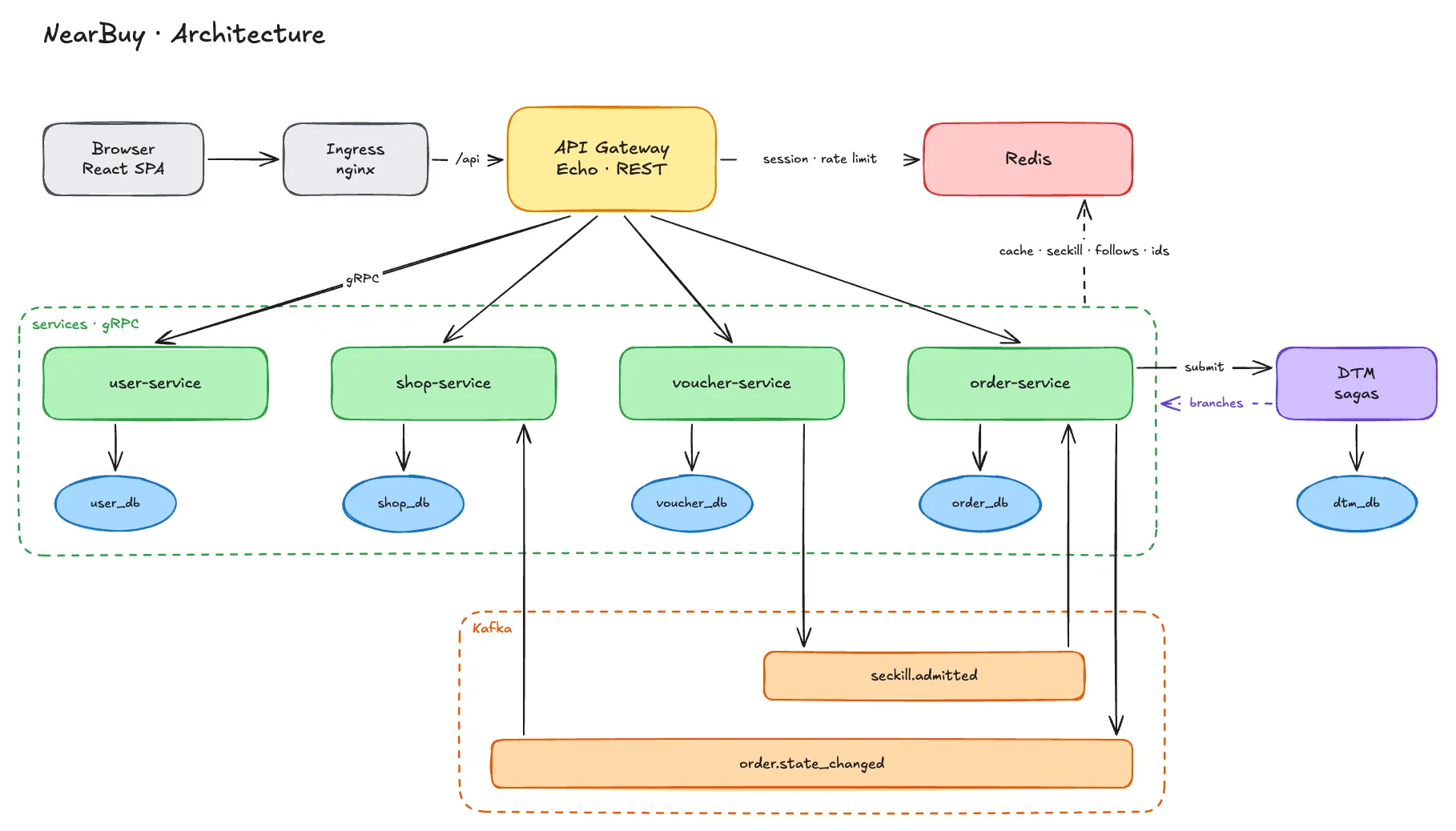
Architecture
Overview
Login Session
Rate Limit
Cache Aside (Shop)
FlashSale
Kafka
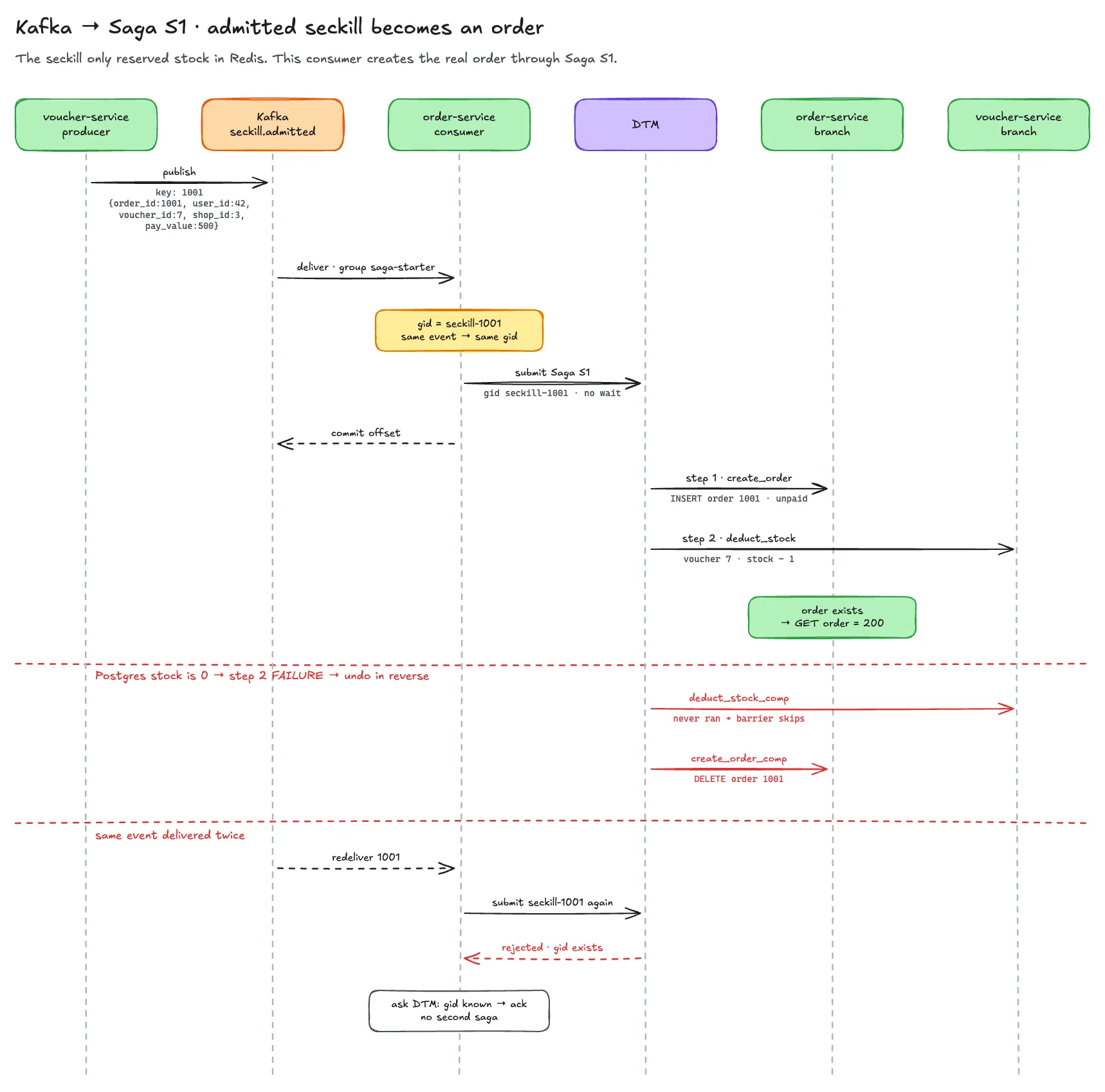
seckill.admitted -> start Saga S1
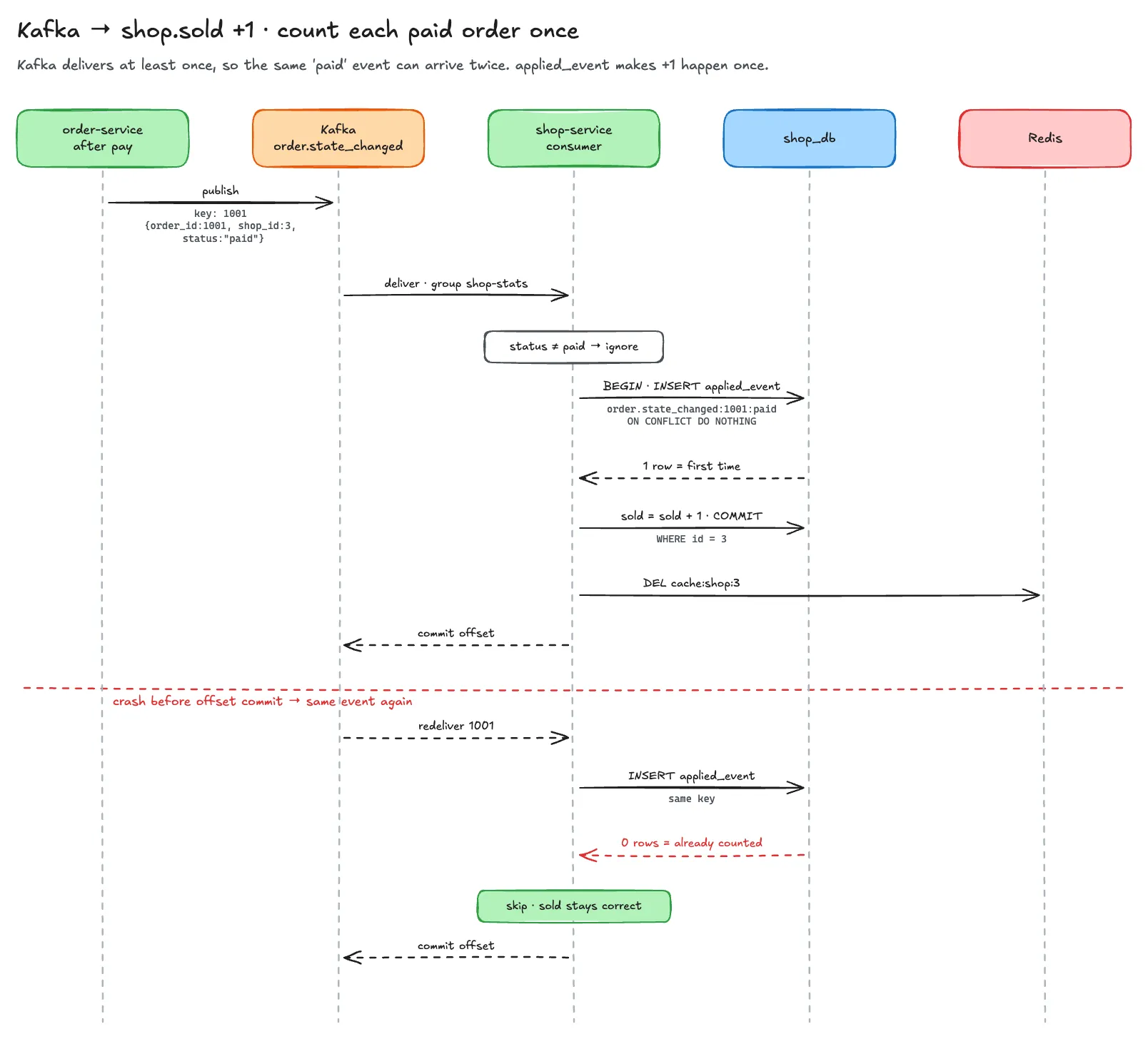
order.state_changed -> shop.sold + 1 (dedup)
Saga
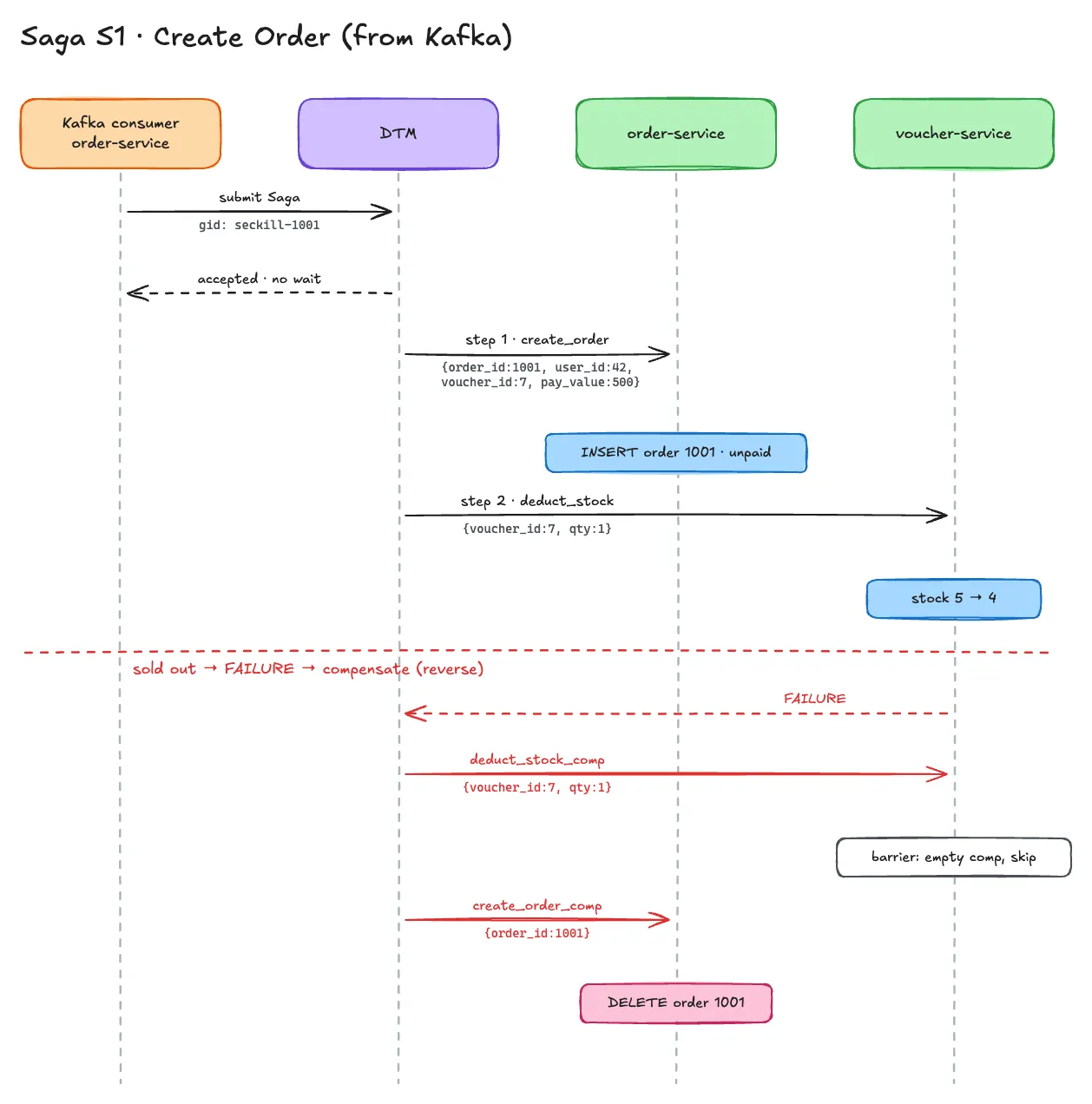
S1 - Create Order
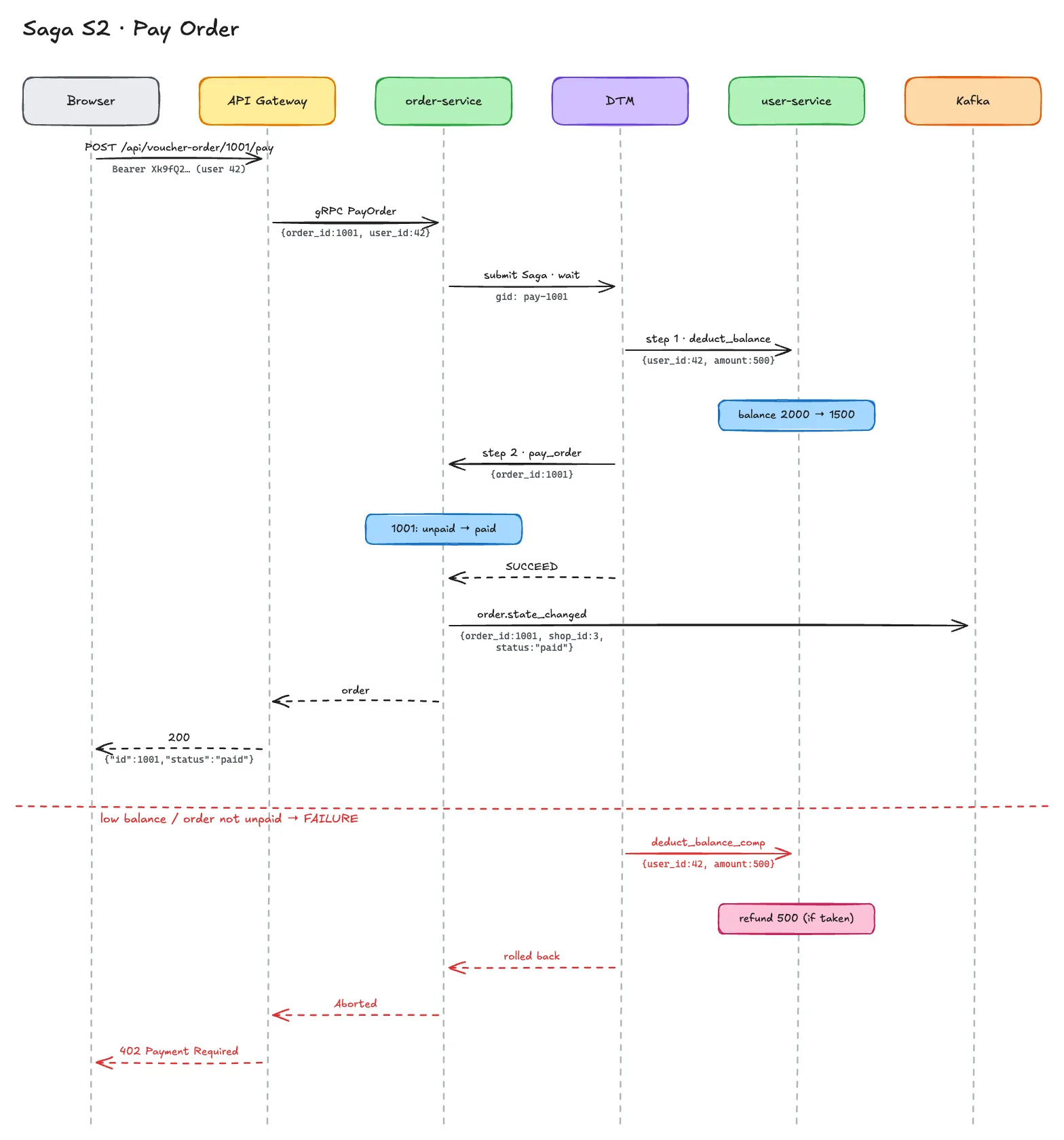
S2 - Pay Order
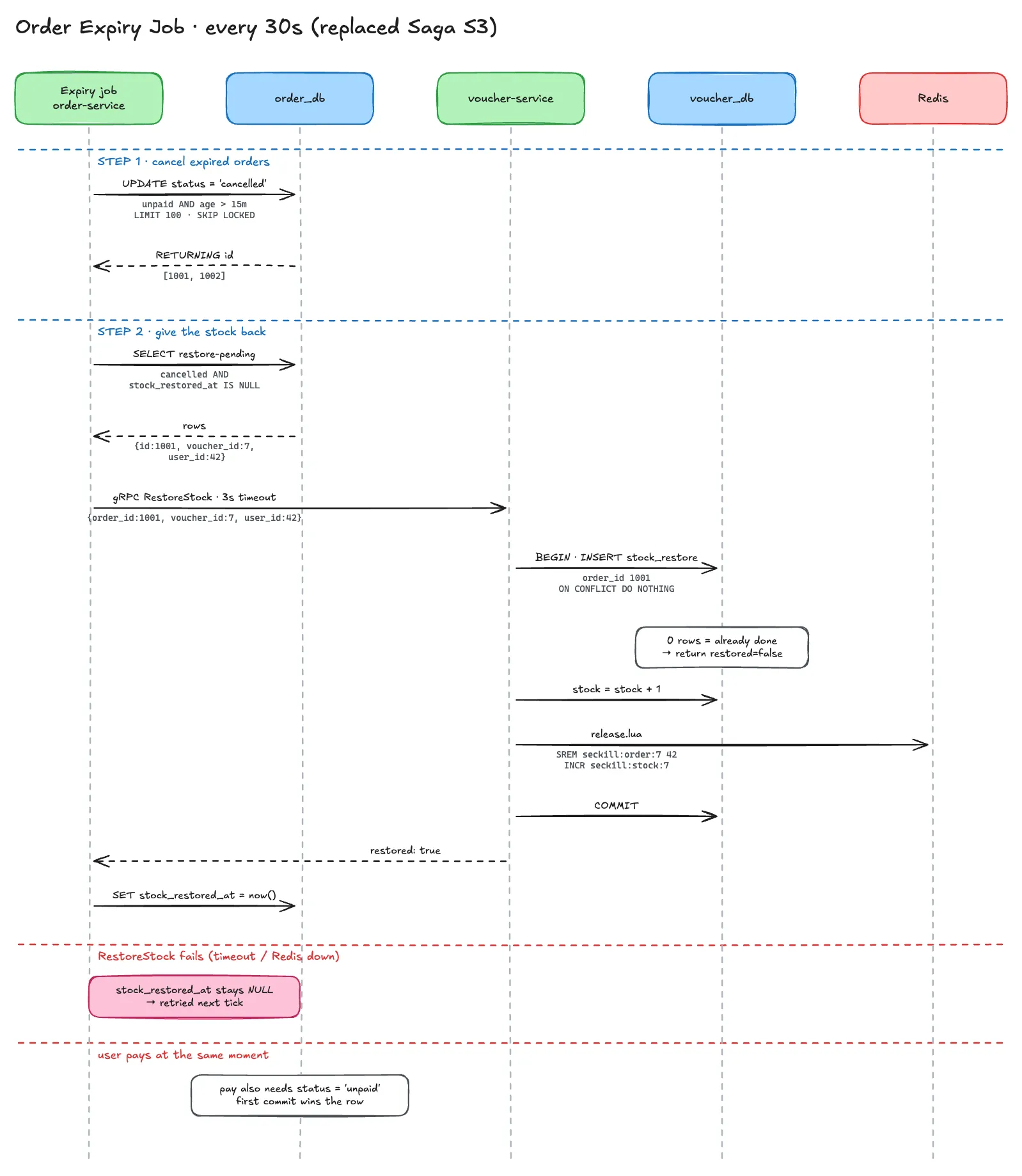
Order Expiry Job
User Journey
make up        # backend
make frontend  # http://localhost:5173
Test users (all login with SMS code, dev mode will fill in the code for you)
| Name | Phone | Role | Balance |
|---|---|---|---|
| Ahmad Faizal | 0123456789 | user | RM 1,000 |
| Tan Mei Ling | 0198765432 | user | RM 1,000 |
| Ravi Kumar | 01123456780 | user | RM 0 |
| NearBuy Admin | 0100000000 | admin | RM 0 |
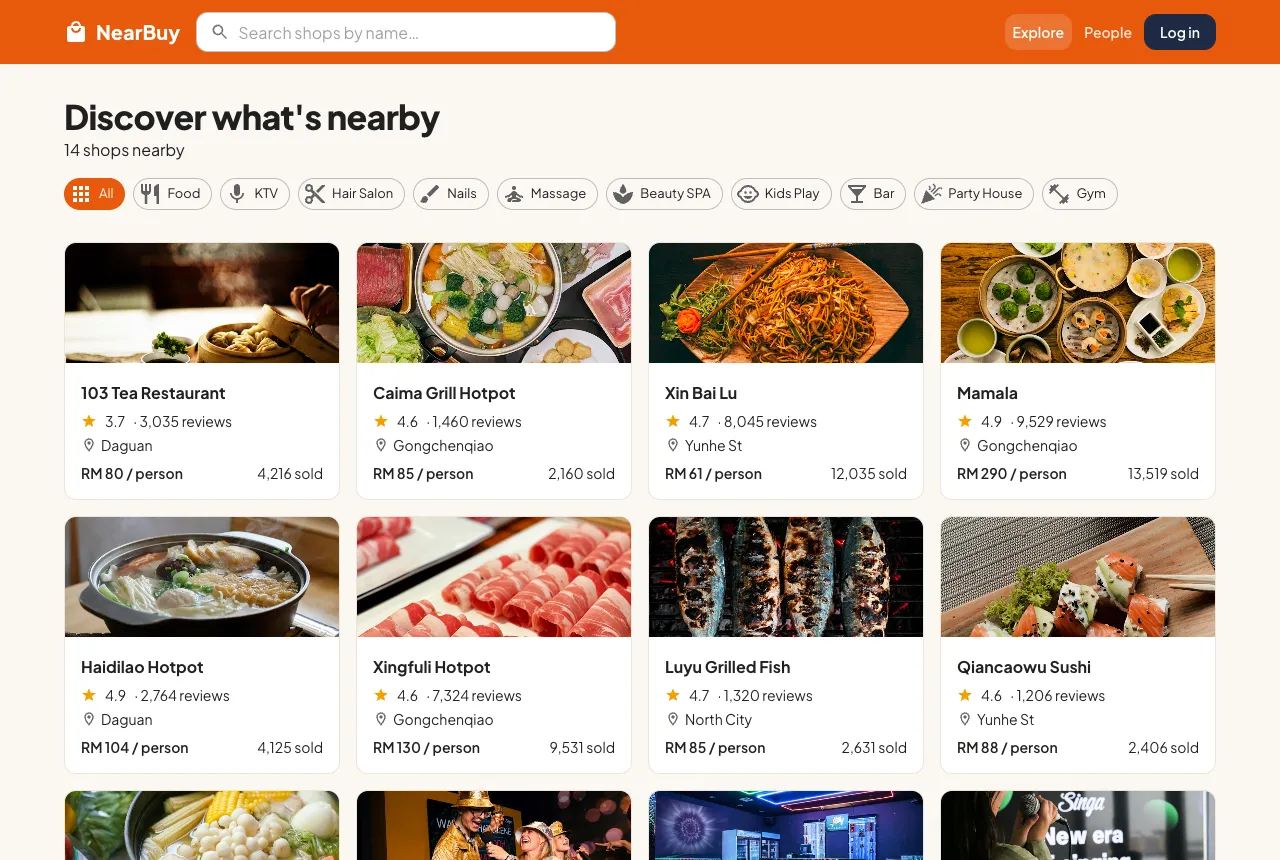
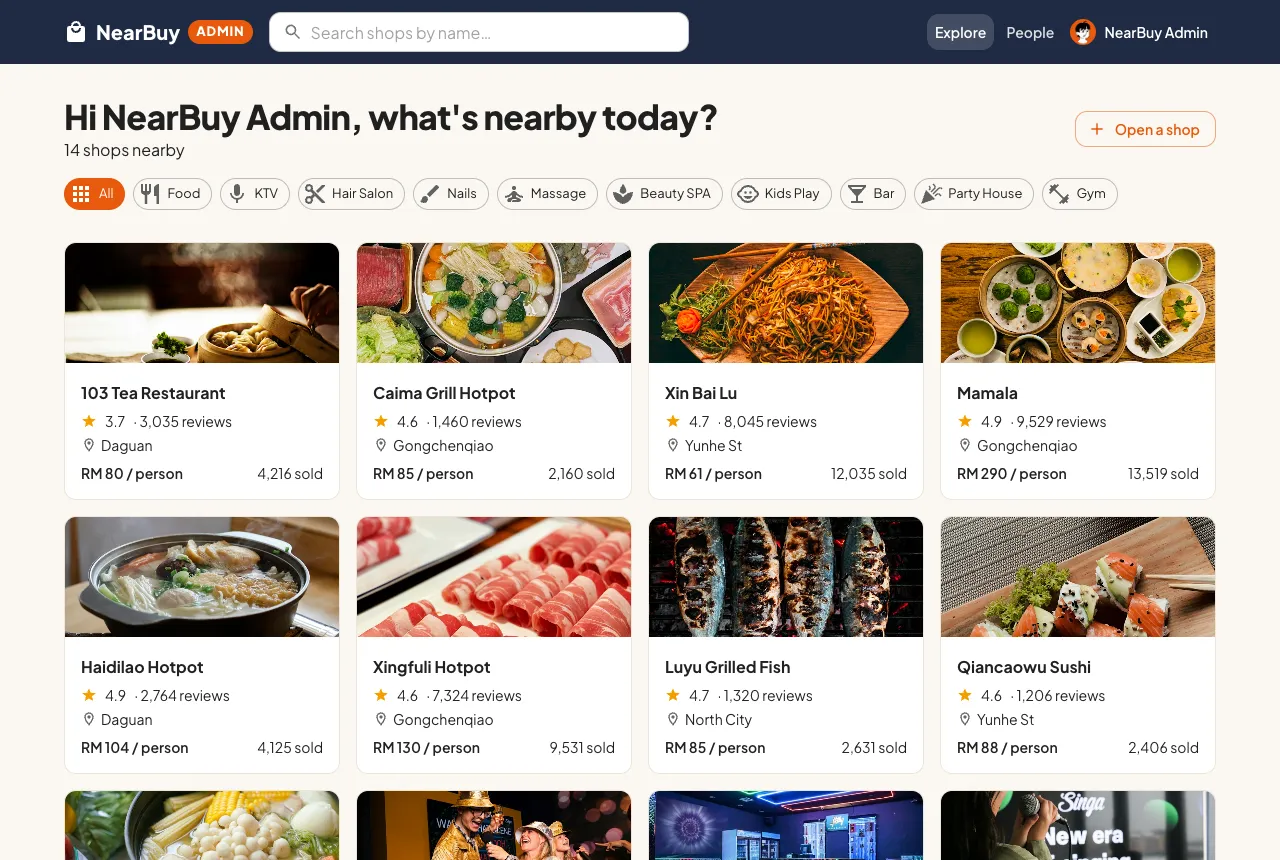
1. Explore (no login)
- Filter by category, or search shop name at the top
- Click a shop to see detail and voucher
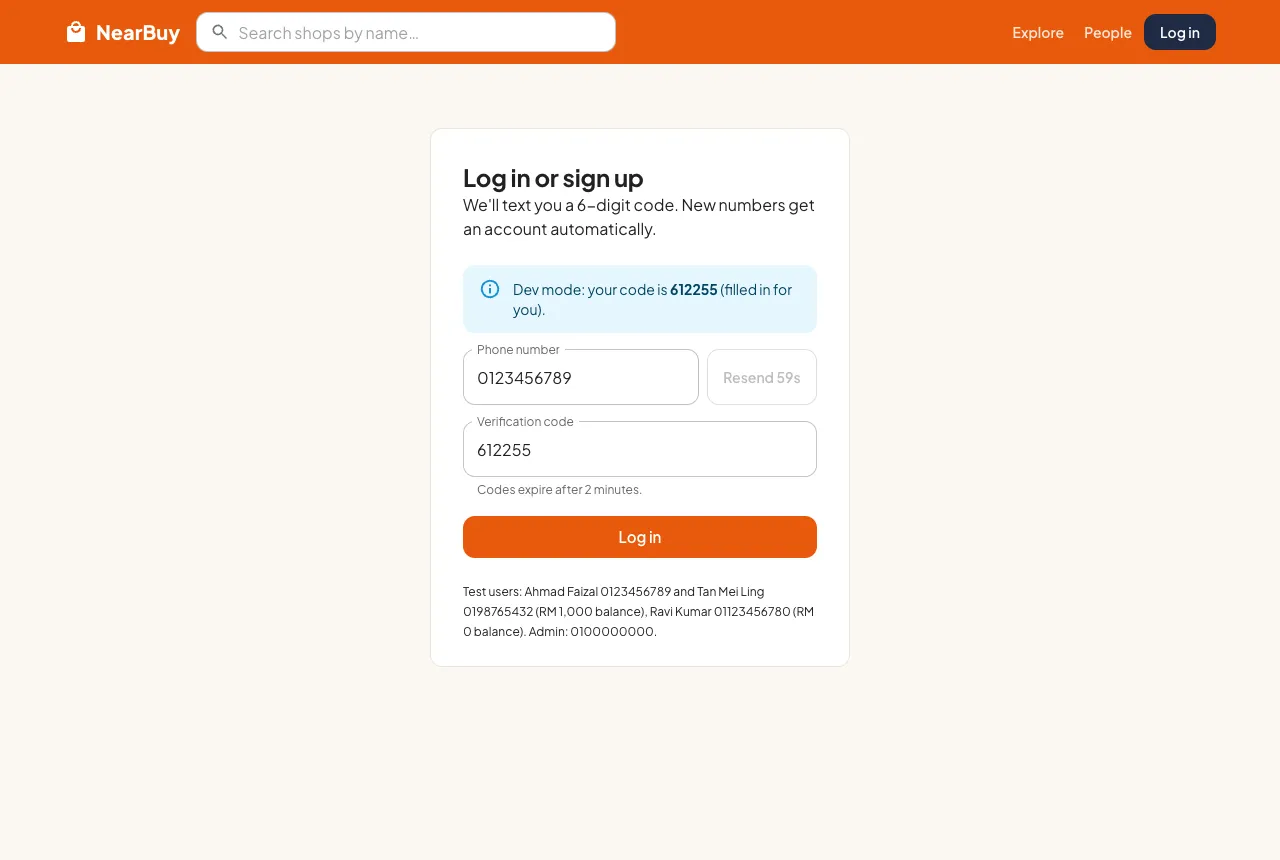
2. Login
- Key in phone -> Send code -> Log in
- New phone number will create new account
3. Admin - Add a flash sale voucher
-
Login as 0100000000, nav bar turn dark with ADMIN tag
-
Open a shop to edit it, or “Open a shop” to create new one
-
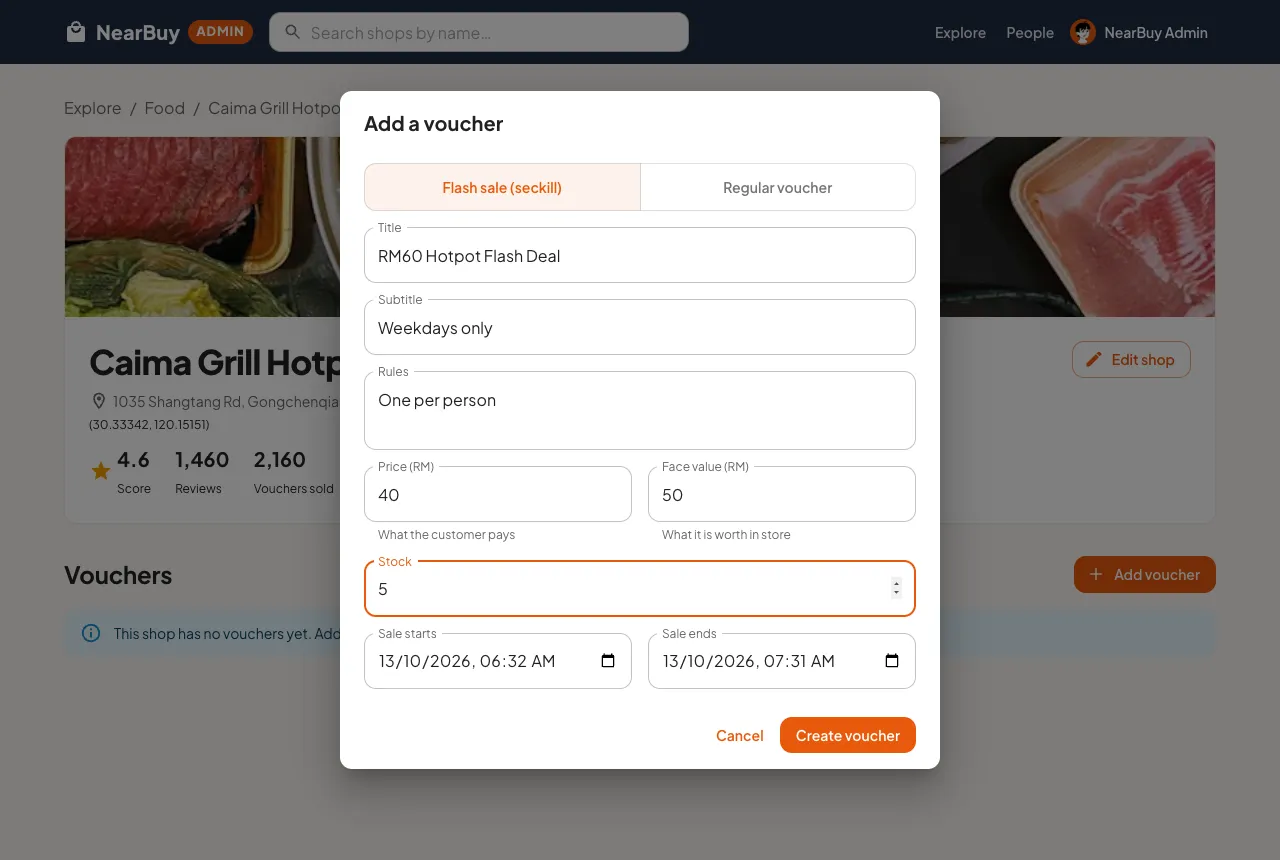
Shop detail -> Add voucher -> Flash sale (seckill)
-
Set price, face value, stock, sale start/end
-
Default sale start is 1 minute later
-
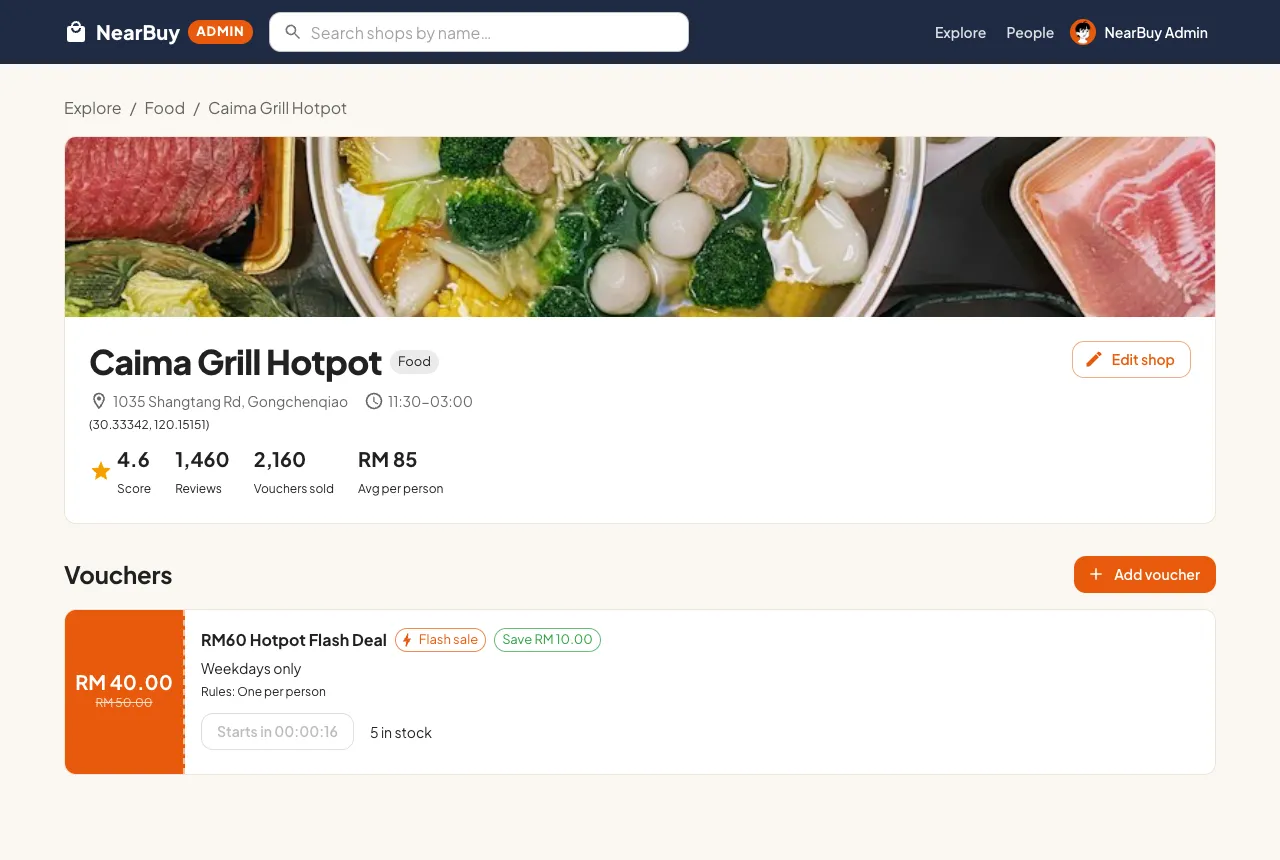
Voucher show countdown until sale start
-
Admin cannot buy
4. Customer - Grab the voucher
-
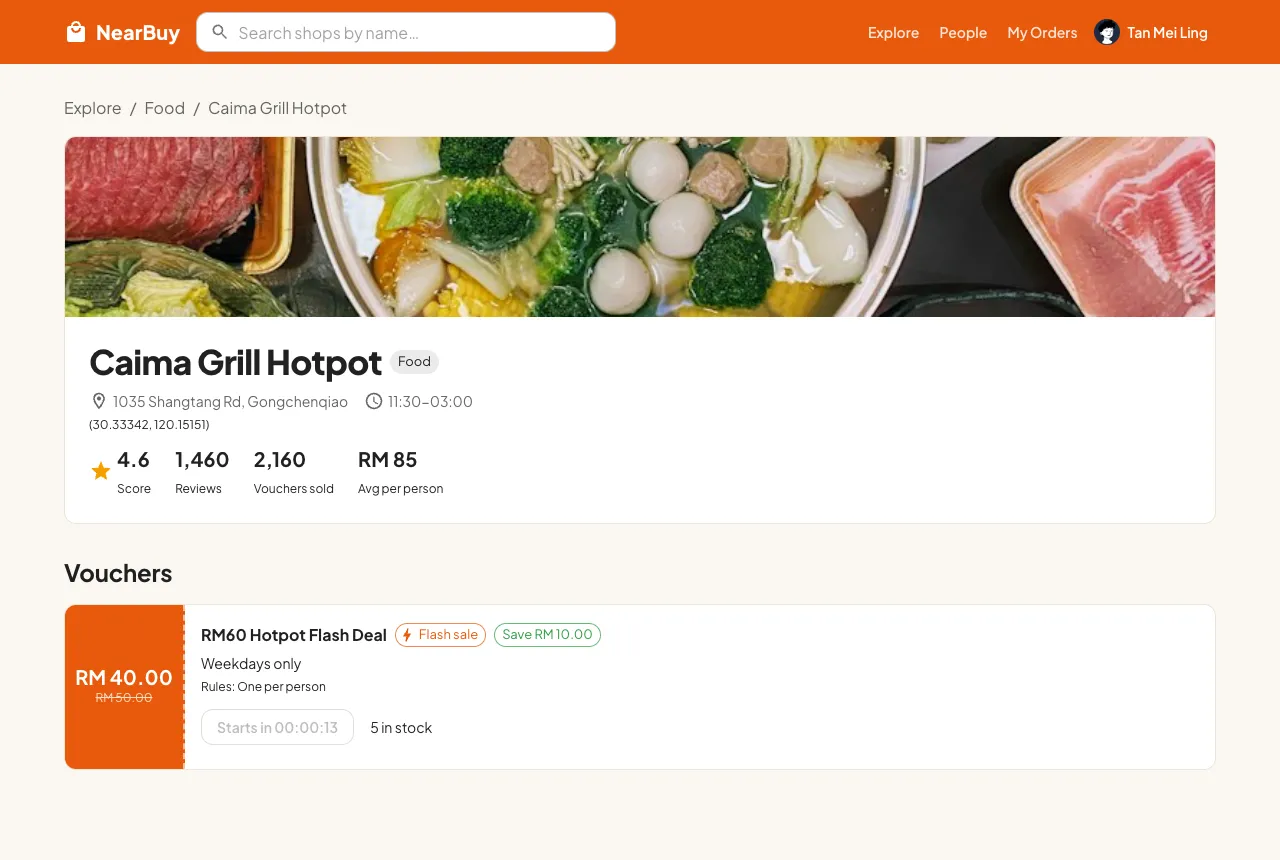
Login as Tan Mei Ling 0198765432, open the same shop
-
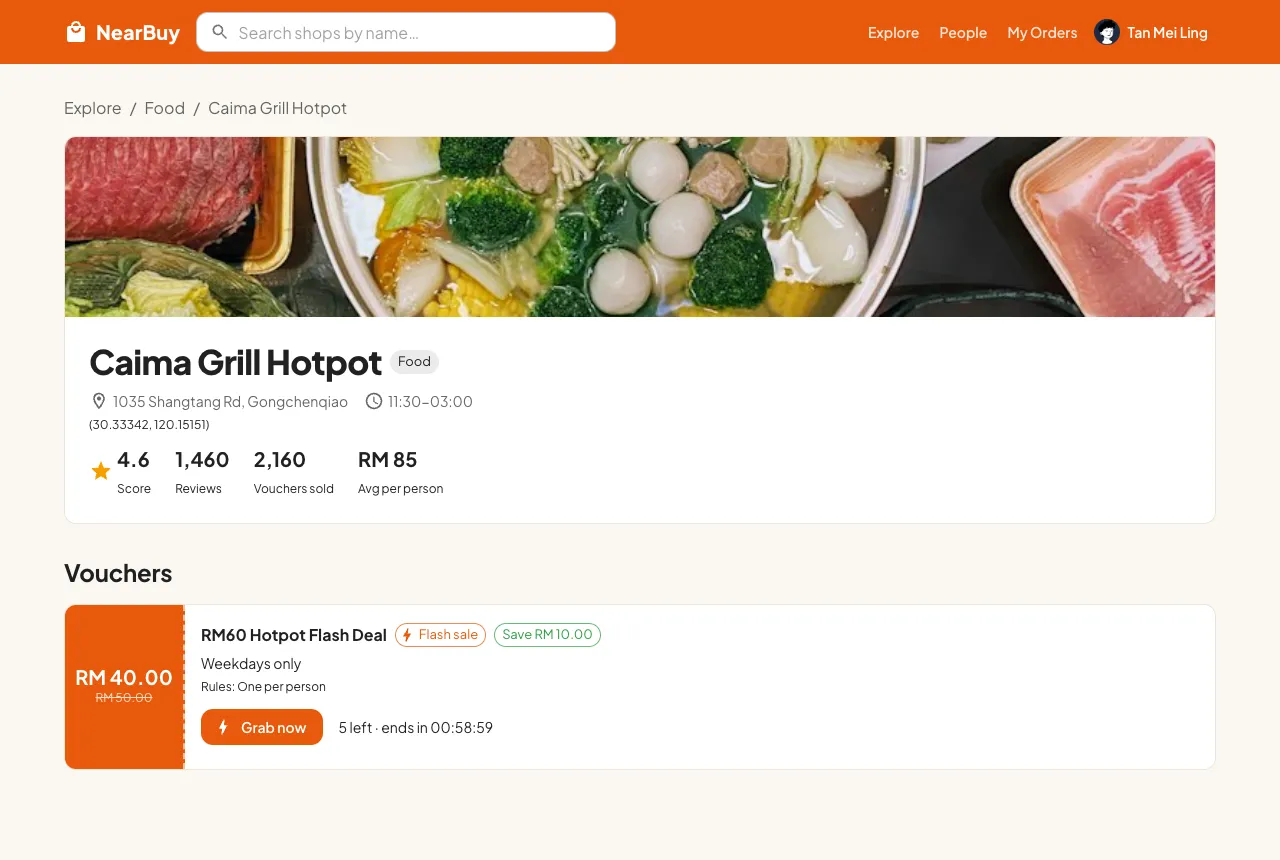
Before sale start, button disabled with countdown
-
Sale start -> Grab now
5. Customer - Pay
-
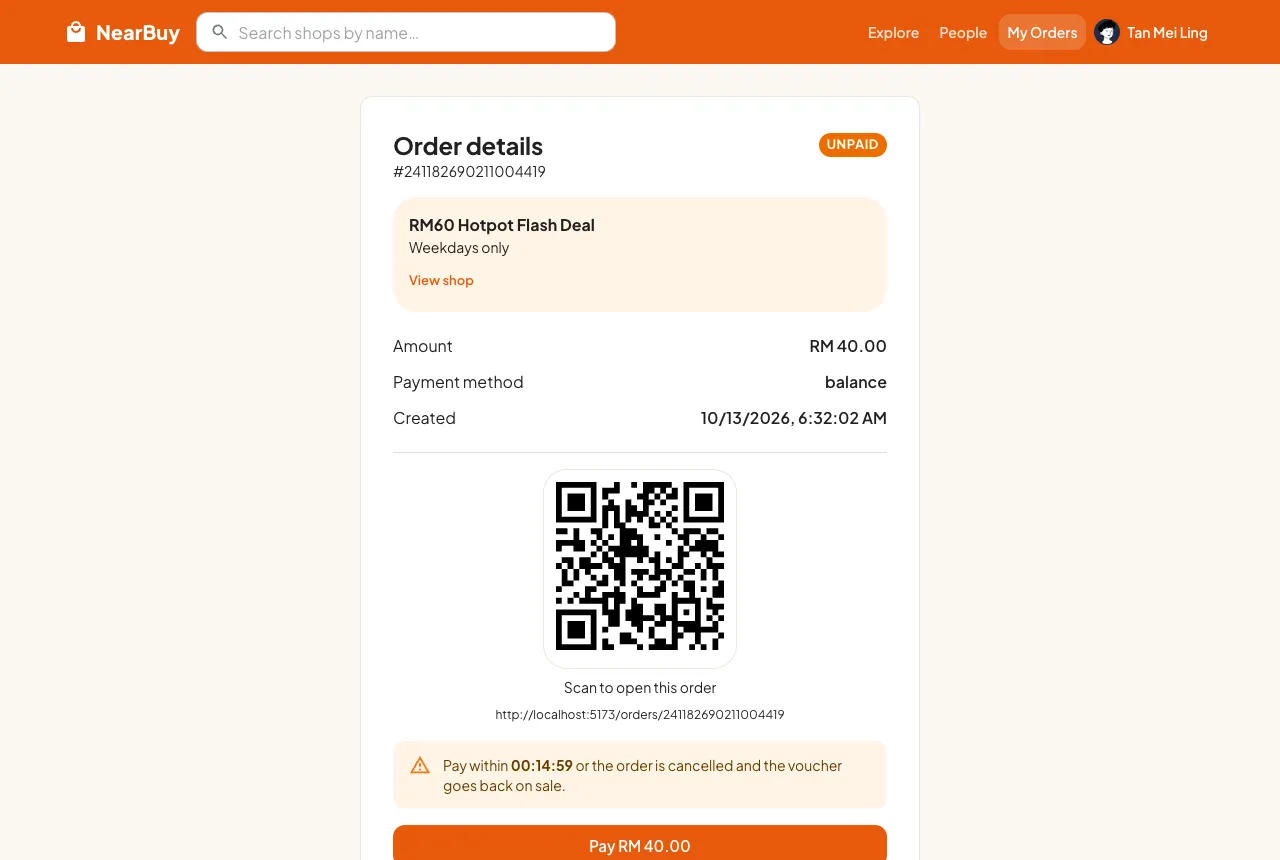
After grab, go to order detail, status UNPAID
-
Pay within 15 minutes, or order cancel and the voucher go back on sale
-
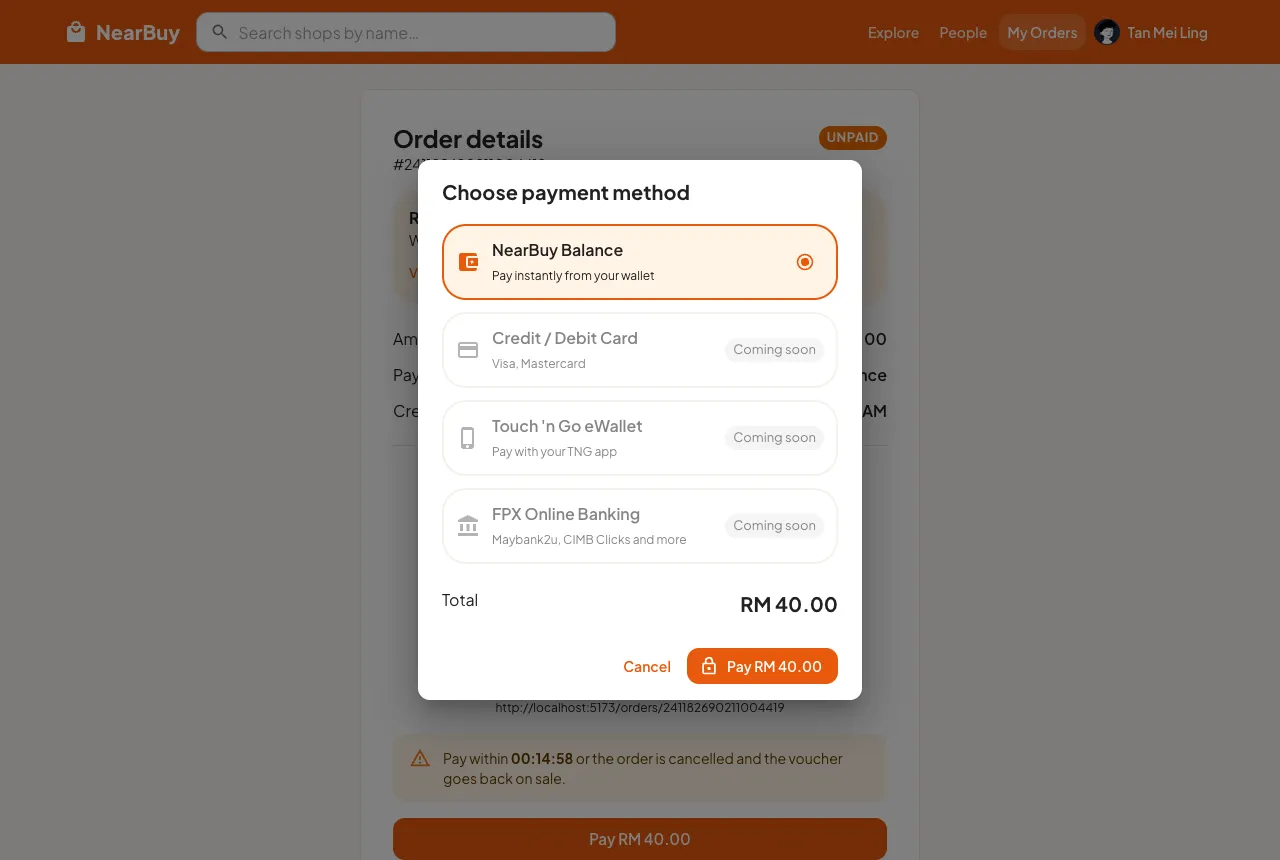
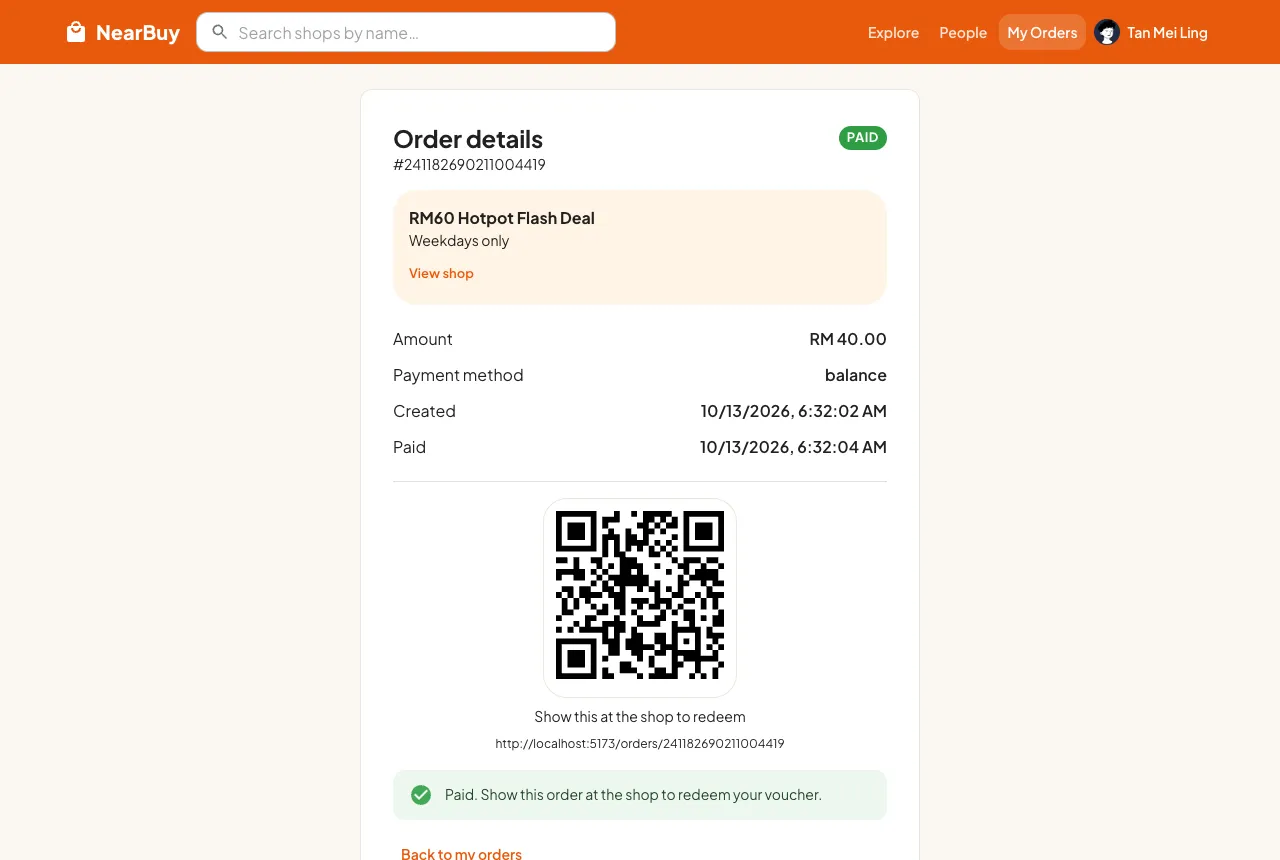
Pay -> choose NearBuy Balance (others coming soon) -> Pay
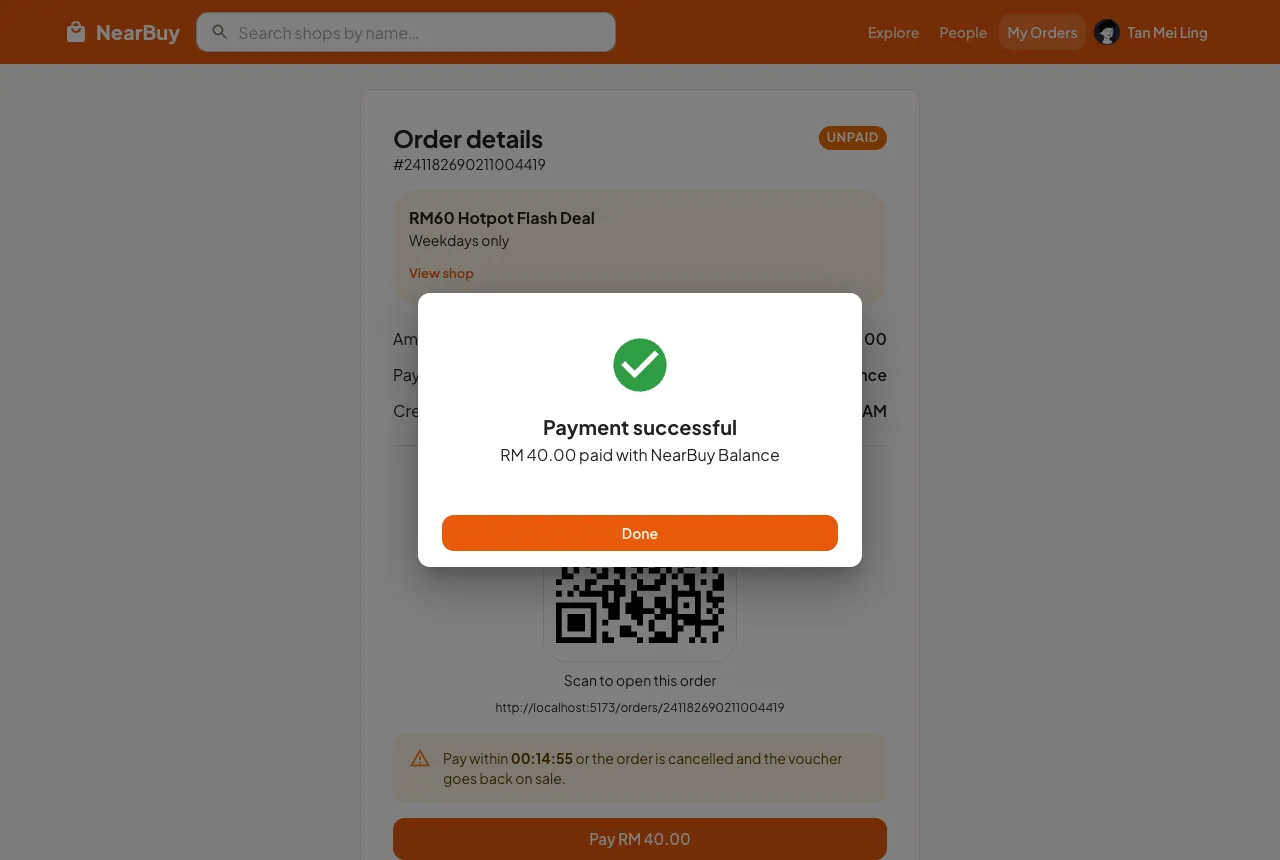
- Order become PAID, show the QR at the shop to redeem
6. Customer - My Orders
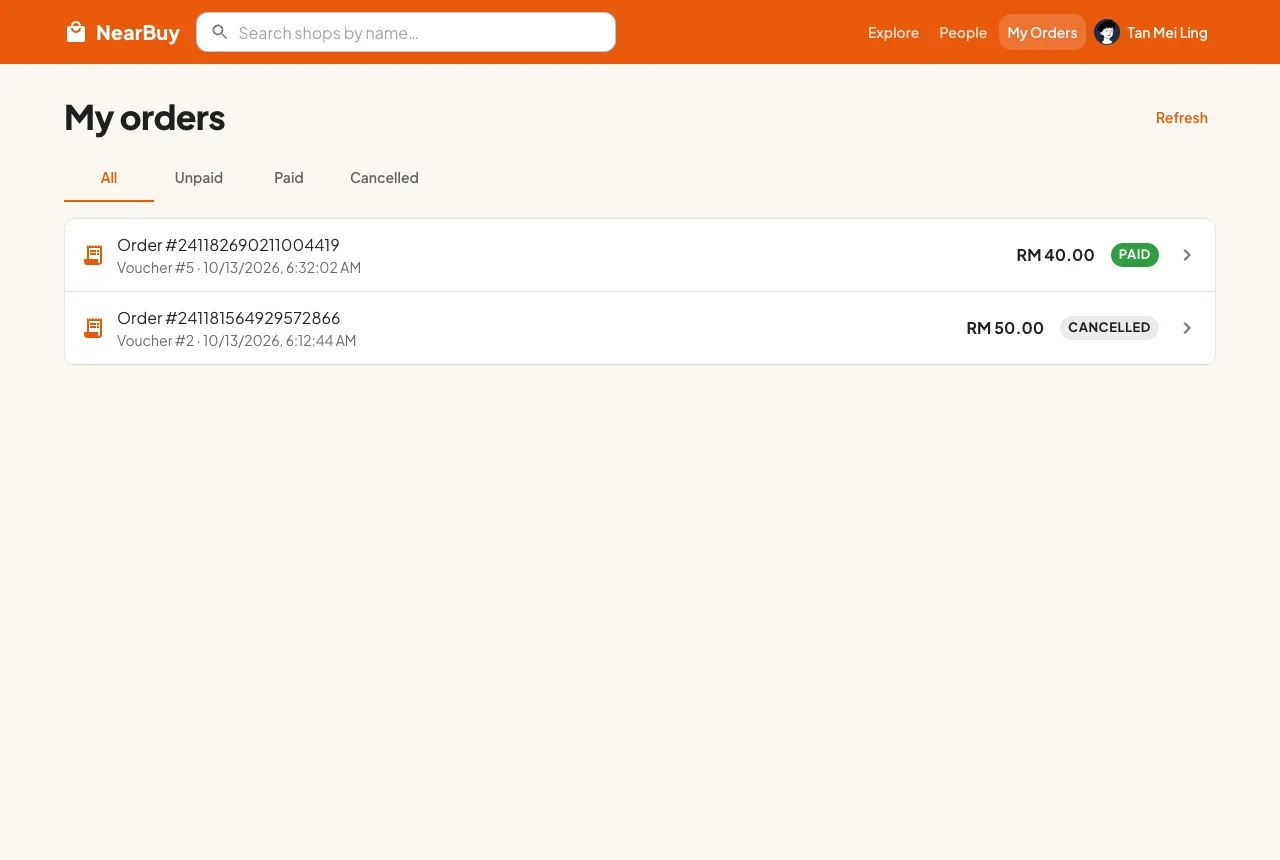
- Filter by All / Unpaid / Paid / Cancelled
- Cancelled one is the expired order (not paid in 15 mins)
7. People - Follow
-
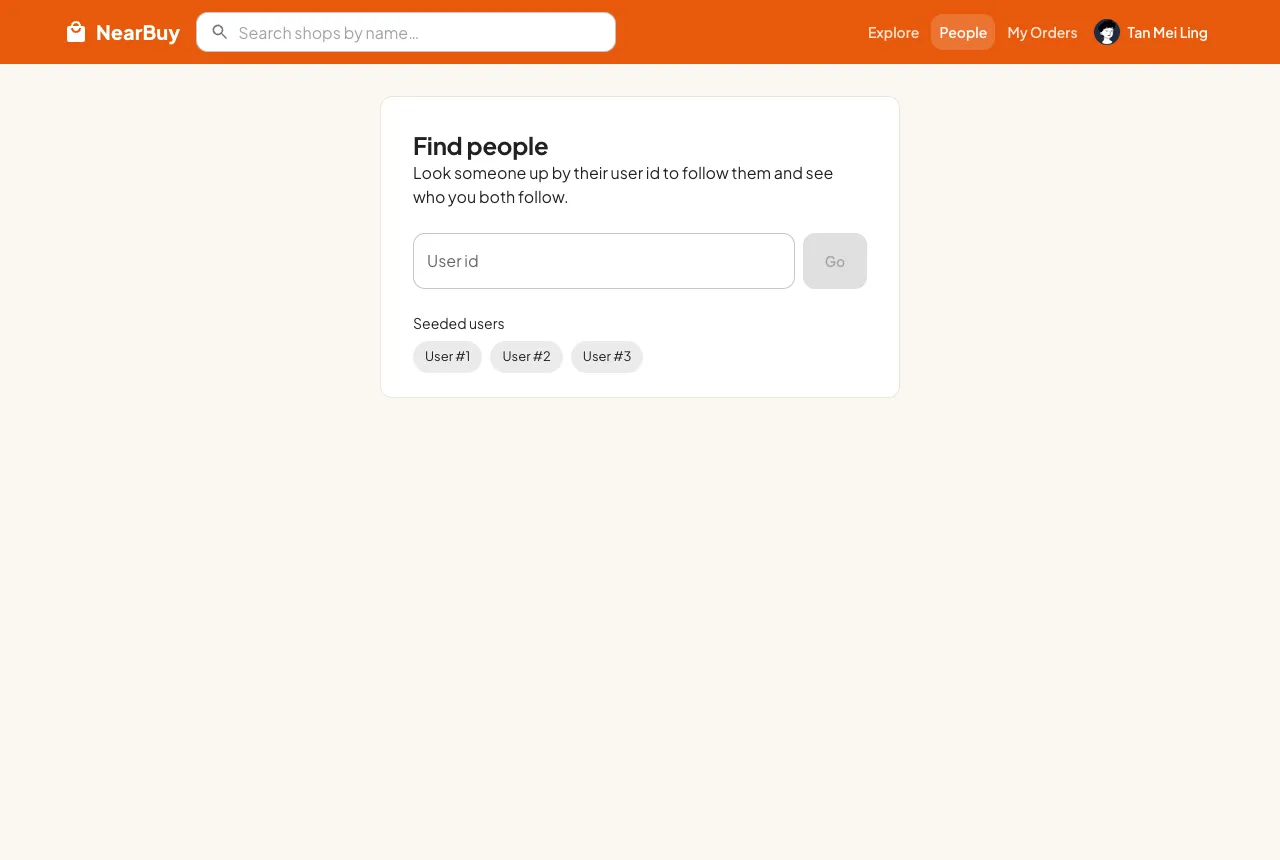
People -> key in user id or click seeded user
-
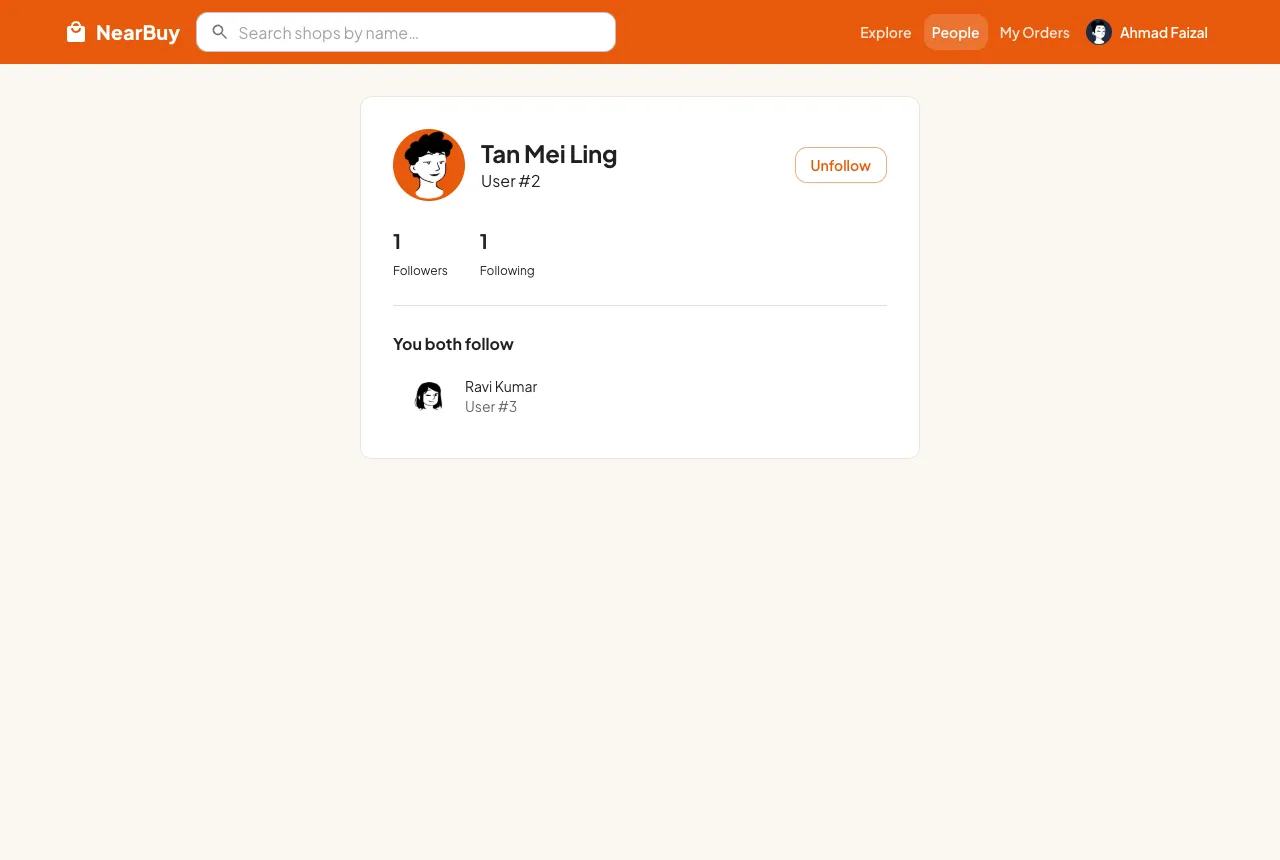
Follow / Unfollow, follower and following count
-
“You both follow” show the common following
Install the tools (one time)
# Install docker becuase kind runs Kubernetes inside Docker
brew install --cask docker

# Install kind, kubectl and tilt for kubernetes deployment
brew install kind kubectl tilt-dev/tap/tilt

# Install migrate, sqlc, libpq, redis and go
brew install golang-migrate sqlc libpq redis go

# Install protobuf
brew install protobuf
go install google.golang.org/protobuf/cmd/protoc-gen-go@latest
go install google.golang.org/grpc/cmd/protoc-gen-go-grpc@latest

# Install node for the frontend
brew install node
Stop and Clean up
make migrate-down # remove all applied migrations from db
make down         # tilt down: removes the app, keeps the cluster
make nuke         # deletes the whole kind cluster
Startup the Application
# 1. Create the cluster
make bootstrap- make cluster: kind create cluster –config ./deploy/kind/cluster-nearbuy.yaml (1 control-plane node and 3 workers)
- make ingress: install ingress-nginx and wait for the controller ready
# 2. Start the app
make up

# Press space to open the Tilt UI at http://localhost:10350 and wait for all resources done running- make up: same as tilt up where it starts
- config, postgres, redis, kafka
- migration for migrate-user/shop/voucher/order/dtm (Run on laptop through the postgres 5432 port-forward)
- sqlc to generate repository go code
- kafka-topic to create topic
- dtm
- user, shop, voucher, order services and api-gateway
# 3. Check the pod
kubectl get pods
Output:
NAME                               READY   STATUS
api-gateway-78cd98c8-4thbn         1/1     Running
dtm-68464bd45d-8m2w4               1/1     Running
kafka-0                            1/1     Running
kafka-topics-c2kq5                 0/1     Completed
order-service-6cc8b597c8-rsr9b     1/1     Running
postgres-0                         1/1     Running
redis-7ff748769-wb79j              1/1     Running
shop-service-c574df9b8-82cjb       1/1     Running
user-service-776c9f6f45-lgvqm      1/1     Running
voucher-service-5b95d5c877-4q2dj   1/1     Running
# 4. Test the application working
curl localhost/api/pingOutput:
{"message":"pong","pod":"api-gateway-78cd98c8-4thbn"}# 5. Start the frontend (npm install on first run)
make frontend
# open http://localhost:5173Check all the database, redis, and kafka
- make psql = psql “postgres://postgres:postgres@localhost:5432/
- make redis = redis-cli -h localhost -p 6379 Because both 5432 and 6379 have been port-forward (Refer to this), so we can access then through our laptop localhost:5432 and localhost:6379
Postgres (Check the db and table)
user_db
make psql DB=user_db ARGS="-c 'SELECT id, phone, nick_name, balance, role FROM app_user;'"
make psql DB=user_db ARGS="-c 'SELECT * FROM follow;'"
Output:
- app_user have 3 seeded users and 1 admin
 id |    phone    |   nick_name   | balance | role
----+-------------+---------------+---------+-------
  1 | 0123456789  | Ahmad Faizal  |  100000 | user
  2 | 0198765432  | Tan Mei Ling  |  100000 | user
  3 | 01123456780 | Ravi Kumar    |       0 | user
4 | 0100000000 | NearBuy Admin | 0 | admin- follow is empty
shop_db
make psql DB=shop_db ARGS="-c 'SELECT id, name, sort_order FROM shop_type ORDER BY sort_order;'"
make psql DB=shop_db ARGS="-c 'SELECT id, name, type_id, area, avg_price, sold, score FROM shop ORDER BY id;'"
make psql DB=shop_db ARGS="-c 'SELECT * FROM applied_event ORDER BY applied_at DESC LIMIT 20;'"
Output:
- 10 shop_types
- 14 shops
- empty applied_event
voucher_db
make psql DB=voucher_db ARGS="-c 'SELECT id, shop_id, title, pay_value, actual_value, type, status FROM voucher ORDER BY id;'"
make psql DB=voucher_db ARGS="-c 'SELECT voucher_id, stock, begin_time, end_time FROM seckill_voucher;'"
make psql DB=voucher_db ARGS="-c 'SELECT * FROM stock_restore;'"
Output:
- Empty voucher, seckill voucher and stock_restore
order_db
make psql DB=order_db ARGS="-c 'SELECT id, user_id, voucher_id, shop_id, pay_value, status, create_time, pay_time, stock_restored_at FROM voucher_order ORDER BY create_time DESC LIMIT 20;'"Output:
- Empty voucher order
dtm_db
make psql DB=dtm_db ARGS="-c 'SELECT gid, status, create_time, finish_time, rollback_reason FROM trans_global ORDER BY id DESC LIMIT 20;'"
make psql DB=dtm_db ARGS="-c 'SELECT gid, branch_id, op, status, url FROM trans_branch_op ORDER BY id DESC LIMIT 20;'"
Output:
- All of empty now
trans_globalhas one row per saga.- The gid shows which saga it is:
- seckill-(id) S1
- pay-(id) S2
- status is succeed, failed or submitted
- (S3 expire saga is removed, now is a expiry job in order-service, refer to this)
- The gid shows which saga it is:
trans_branch_ophas one row per branch call (action or compensate).
DTM barrier tables (user_db, voucher_db, order_db)
make psql DB=user_db    ARGS="-c 'SELECT gid, branch_id, op, reason, create_time FROM dtm_barrier.barrier ORDER BY id DESC LIMIT 20;'"
make psql DB=voucher_db ARGS="-c 'SELECT gid, branch_id, op, reason, create_time FROM dtm_barrier.barrier ORDER BY id DESC LIMIT 20;'"
make psql DB=order_db   ARGS="-c 'SELECT gid, branch_id, op, reason, create_time FROM dtm_barrier.barrier ORDER BY id DESC LIMIT 20;'"
Output user/voucher/order_db > dtm_barrier (schema) > barrier (table) are empty
Check Migrations Status
for db in user_db shop_db voucher_db order_db dtm_db;
	make -s psql DB=$db ARGS="-c 'SELECT current_database(), version, dirty FROM schema_migrations;'";
end
Output:
| current_database | version | dirty |
|---|---|---|
| user_db | 5 | f |
| shop_db | 3 | f |
| voucher_db | 3 | f |
| order_db | 4 | f |
| dtm_db | 1 | f |
make migrate-reset will reapplied the migration (migrate-down then migrate-up)
Redis (Check the redis status)
make redis ARGS=ping                     # expect PONG
make redis ARGS=dbsize                   # number of keys (1)
make redis ARGS="--scan --pattern '*'"   # list every key
# rl:ip:10.244.0.5 <- from the curl /api/ping just now
Kafka (Check all the topics)
kubectl exec kafka-0 -- /opt/kafka/bin/kafka-topics.sh --bootstrap-server localhost:9092 --listOutput:
__consumer_offsets
order.state_changed
order.state_changed.dlq
seckill.admitted
seckill.admitted.dlq
__consumer_offsets is kafka internal topic, it appear after the consumer (order-service, shop-service) join
User Service
api/user/:id
curl -s localhost/api/user/1 | jq
curl -i localhost/api/user/1
# {"id":1,"nickname":"Ahmad Faizal","icon":"/icons/1.png"}

curl -s localhost/api/user/999 | jq
curl -i localhost/api/user/999
# Output: user not found

curl -s localhost/api/user/abc | jq
curl -i localhost/api/user/abc
# Output: invalid user id
Auth Service
api/user/code
- API Result : SMS Code for that phone number
- SMS Code Expiry Time: 2 minutes
- SMS Code Rate Limiting: every 1 minute only can access 1 code for 1 phone
api/user/login
- Register user if new phone number
- Get user if phone number already exist in db
- API Result: Session Token to access authenticated url
- Session Token Expiry Time: 30 minutes
api/user/me
- Provide the token as Bearer Header
- API Result: token user information
api/user/logout
- Logout the user by deleting session token from redis -> login:token:(token)
Validation for the api
# a malformed phone is rejected
curl -s -X POST http://localhost/api/user/code \
  -H 'Content-Type: application/json' \
  -d '{"phone":"12345"}'
# {"message":"invalid phone number"}


# the code is single-use -- replay it
curl -s -X POST http://localhost/api/user/login \
  -H 'Content-Type: application/json' \
-d '{"phone": "0123456789", "code": "123456"}'

curl -s -X POST http://localhost/api/user/login \
  -H 'Content-Type: application/json' \
-d '{"phone": "0123456789", "code": "123456"}'
# {"message":"code is wrong or expired"} [401]


# a wrong code is indistinguishable from no code
curl -s -X POST http://localhost/api/user/login \
  -H 'Content-Type: application/json' \
  -d '{"phone": "0123456789", "code": "000000"}'
# {"message":"code is wrong or expired"} [401]

# No Token provide to /api/user/me
curl -s http://localhost/api/user/me
# {"message":"authentication required"} [401]

# Invalid Token provide to /api/user/me
curl -s -H 'Authorization: Bearer notatoken' http://localhost/api/user/me
# {"message":"authentication required"} [401]

# No Token provide to /api/user/logout
curl -s -X POST http://localhost/api/user/logout
# {"message":"authentication required"} [401]

# Invalid Token provide to /api/user/logout
curl -s -X POST -H 'Authorization: Bearer notatoken' http://localhost/api/user/logout
# {"message":"authentication required"} [401]
Login with Existing Phone User
make psql DB=user_db ARGS="-c 'SELECT id, phone, nick_name, balance FROM app_user;'"
# id | phone      | nick_name    | balance
#  1 | 0123456789 | Ahmad Faizal | 100000

# Get exist user
curl -X POST http://localhost/api/user/code \
	 -H 'Content-Type: application/json' \
	 -d '{"phone":"0123456789"}'
# {"sent":true,"code":"759090"}


make redis ARGS="TTL 'login:code:0123456789'"
# 120 <- means 2 mins

make redis ARGS="GET 'login:code:0123456789'"
# 759090 <- sms code

# Login user 1
curl -X POST http://localhost/api/user/login \
     -H 'Content-Type: application/json' \
     -d '{"phone": "0123456789", "code": "759090"}'
# {"token":"OxbRP99E-JfGIfvVUb9LZo8DITPLdQMTqXN0x3OGkF4","user":{"id":1,"nickname":"Ahmad Faizal","icon":"/icons/1.png","role":"user"}}

make redis ARGS="GET 'login:code:0123456789'"
# nil means sms code get consume

make redis ARGS="TTL 'login:token:OxbRP99E-JfGIfvVUb9LZo8DITPLdQMTqXN0x3OGkF4'"
# 1800 sec for 30 mins

make redis ARGS="GET 'login:token:OxbRP99E-JfGIfvVUb9LZo8DITPLdQMTqXN0x3OGkF4'"
# "{\"id\":1,\"nickname\":\"Ahmad Faizal\",\"icon\":\"/icons/1.png\",\"role\":\"user\"}"

# No New user will be created because is existing user
make psql DB=user_db ARGS="-c 'SELECT id, phone, nick_name, balance FROM app_user;'"
# id | phone      | nick_name    | balance
#  1 | 0123456789 | Ahmad Faizal | 100000

# Provide token to get user info
curl http://localhost/api/user/me \
	 -H "Authorization: Bearer OxbRP99E-JfGIfvVUb9LZo8DITPLdQMTqXN0x3OGkF4"
# {"id":1,"nickname":"Ahmad Faizal","icon":"/icons/1.png","role":"user"}

# Logout
curl -X POST http://localhost/api/user/logout \
	 -H "Authorization: Bearer OxbRP99E-JfGIfvVUb9LZo8DITPLdQMTqXN0x3OGkF4"

# Provide token to get user info
curl http://localhost/api/user/me \
	 -H "Authorization: Bearer OxbRP99E-JfGIfvVUb9LZo8DITPLdQMTqXN0x3OGkF4"
# {"message":"authentication required"} <- token deleted from redis

make redis ARGS="GET 'login:token:OxbRP99E-JfGIfvVUb9LZo8DITPLdQMTqXN0x3OGkF4'"
# nil <- token remove from redis
Login with New Phone User
# Create new user
curl -X POST http://localhost/api/user/code \
	 -H 'Content-Type: application/json' \
	 -d '{"phone":"0186666666"}'
# {"sent":true,"code":"156221"}

# Login new user (user 5, because admin is user 4)
curl -X POST http://localhost/api/user/login \
     -H 'Content-Type: application/json' \
     -d '{"phone": "0186666666", "code": "156221"}'

# Verify new user (user 5)
make psql DB=user_db ARGS="-c 'SELECT id, phone, nick_name, balance, role FROM app_user;'"
# Output
# id | phone      | nick_name     | balance | role
# 5  | 0186666666 | user_57on2pe9 | 0       | user
Login as Admin
curl -X POST http://localhost/api/user/code \
	 -H 'Content-Type: application/json' \
	 -d '{"phone":"0100000000"}'
# {"sent":true,"code":"840173"}

curl -X POST http://localhost/api/user/login \
     -H 'Content-Type: application/json' \
     -d '{"phone": "0100000000", "code": "840173"}'
# {"token":"TKQFwxHLb0a_EYWxAf-JpWLfNsYA9micqebU7bGiYyw","user":{"id":4,"nickname":"NearBuy Admin","icon":"/icons/admin.png","role":"admin"}}
Role
- admin: create/edit shop, create voucher. Cannot grab, pay or follow
- user (customer): grab, pay, follow. Cannot create/edit shop or voucher
# user try to edit shop
curl -s -X PATCH localhost/api/shops/1 -H "Authorization: Bearer <user token>" \
     -H 'Content-Type: application/json' -d '{"name":"x"}'
# {"message":"admin only"} [403]

# admin try to follow
curl -s -X PUT localhost/api/users/1/follow -H "Authorization: Bearer <admin token>"
# {"message":"admins cannot do this"} [403]
Rate-Limiting
Key: rl:ip:(ip) Purpose: Stops one client flooding the API. Applies to every /api/* request, logged in or public Limit Time: 100 try per min Example:
# fire 103 at a 100-capacity bucket (/api/ping is public, no token needed)
for i in (seq 1 103)
    curl -s -o /dev/null -w '%{http_code} ' http://localhost/api/ping
end
echo
# 200 200 200 ... (100 times) ... 200 429 429 429

make redis ARGS="--scan --pattern 'rl:ip:*'"
# "rl:ip:10.244.0.5"

curl -s -D - -o /dev/null http://localhost/api/ping | grep -i ratelimit
# X-Ratelimit-Limit: 100
# X-Ratelimit-Remaining: 5Key: rl:user:(id):(METHOD):(path) Purpose: Stops one logged-in user spam one endpoint. Each route has its own bucket for a logged-in user Limit Time: 10 try per min Example:
# fire 13 at a 10-capacity bucket
for i in (seq 1 13)
    curl -s -o /dev/null -w '%{http_code} ' -H "Authorization: Bearer 2i8zTohc7TEZiBFPng0kHk2NMUe3ajwVVXeXZVtaaGc" http://localhost/api/user/me
end
echo
# 200 200 200 200 200 200 200 200 200 200 429 429 429

make redis ARGS="--scan --pattern 'rl:user:*'"
# "rl:user:1:GET:/api/user/me"Key: rl:sms:(phone) Purpose: Stops SMS spam to one phone number. Limit Time: 1 try per min Example:
curl -X POST http://localhost/api/user/code \
	 -H 'Content-Type: application/json' \
	 -d '{"phone":"0123456789"}'
# {"sent":true,"code":"664215"}

curl -X POST http://localhost/api/user/code \
	 -H 'Content-Type: application/json' \
	 -d '{"phone":"0123456789"}'
# {"message":"rate limit exceeded: per-phone-sms"}

make redis ARGS="TTL 'rl:sms:0123456789'"
# 60 <- means 1 mins

make redis ARGS="HGETALL rl:sms:0123456789"
#  1) "tokens"
#  2) "0" (Tokens left after the last request, used to only one when sent the code)

#  3) "ts"
# 4) "1791824645892" (Time of that request, Tue 13 Oct 2026 01:04:05.892)Key: rl:login:(phone) Purpose: Stops brute-forcing a 6-digit code. Limits login attempts per phone. Limit Time: 5 try per 10 min Example:
# fire 13 login attempt to /api/user/login
for i in (seq 1 13)
	curl -s -o /dev/null -w '%{http_code} ' -X POST http://localhost/api/user/login \
     -H 'Content-Type: application/json' \
     -d '{"phone": "0123456789", "code": "759090"}'
end
echo
# 401 401 401 401 401 429 429 429 429 429 429 429 429

make redis ARGS="--scan --pattern 'rl:login:*'"
# "rl:login:0123456789"
Shop Service
make psql DB=shop_db ARGS="-c 'SELECT id, name, sort_order FROM shop_type ORDER BY sort_order;'"
# id |    name     | sort_order
#----+-------------+------------
#  1 | Food        |          1
#  2 | KTV         |          2
#  3 | Hair Salon  |          3
# 10 | Nails       |          4
#  5 | Massage     |          5
#  6 | Beauty SPA  |          6
#  7 | Kids Play   |          7
#  8 | Bar         |          8
#  9 | Party House |          9
#  4 | Gym         |         10

make psql DB=shop_db ARGS="-c 'SELECT id, name, type_id, area, avg_price, sold, score FROM shop ORDER BY id;'"
# id | name               | type_id | area   | avg_price | sold | score
# 1  | 103 Tea Restaurant | 1       | Daguan | 80        | 4215 | 37
# ...


curl -s http://localhost/api/shops/1 | jq -c '{id, name, area}'
# {"id":1,"name":"103 Tea Restaurant","area":"Daguan"}

curl -s 'http://localhost/api/shops?type_id=1&page=1&page_size=3' | jq -c '{total, names: [.shops[].name]}'
# {"total":9,"names":["103 Tea Restaurant","Caima Grill Hotpot","Xin Bai Lu"]}

curl -s 'http://localhost/api/shops?name=KTV' | jq -c '[.shops[].name]'
# ["Kaledi KTV","INLOVE KTV","Mei KTV","OuK La KTV","Xingjuhui KTV"]

curl -s http://localhost/api/shop-types | jq -r '.[0:3][] | .name'
# Food
# KTV
# Hair Salon
The postgres result will store in redis
make redis ARGS="FLUSHALL"
curl -s -o /dev/null http://localhost/api/shops/1
curl -s -o /dev/null -w '%{http_code}\n' http://localhost/api/shops/999999   # 404
curl -s -o /dev/null http://localhost/api/shop-types

make -s redis ARGS="GET cache:shop:1" | head -c 60
# {"id":1,"name":"103 Tea Restaurant","type_id":1,"images":"/i

make -s redis ARGS="TTL cache:shop:1"
# 1800 - 30 minutes

make -s redis ARGS="GET cache:shop:999999"
# "__nil__" - avoids cache penetration (without it, someone could keep requesting shop 999999 and every request would hit Postgres)

make -s redis ARGS="TTL cache:shop:999999"
# 120 - 2 minutes
# the nil entry has a shorter TTL because that shop may be created later

make -s redis ARGS="GET cache:shop-types" | head -c 60
# [{"id":1,"name":"Food","icon":"/types/ms.png","sort_order":1

make -s redis ARGS="TTL cache:shop-types"
# 86400 - 24 hours (shop types almost never change)
FLUSHALL also delete the seckill:stock:* key, voucher-service only warm it on startup or create seckill voucher
Test Cache when postgers is down
# Set the result (shop 1 and shop 999999) to cache
curl -s -o /dev/null http://localhost/api/shops/1
curl -s -o /dev/null -w '%{http_code}\n' http://localhost/api/shops/999999   # 404

# Scale the postgres to 0
kubectl scale statefulset/postgres --replicas=0
kubectl wait --for=delete pod/postgres-0 --timeout=60s

# got cache, no db
curl -i http://localhost/api/shops/1
# 200 ok

# got cache, no db
curl -i http://localhost/api/shops/999999
# 404 ok

# no cache, no db
curl -i http://localhost/api/shops/7
# 500 due to postgres down and no cache

# no cache, no db
curl -i http://localhost/api/shops/888888
# 500 due to postgres down and no cache

kubectl scale statefulset/postgres --replicas=1
Cache Invalidation when updating the shop to new value
- It will update the db, then delete the cache (cache-aside problem - consistency between db and cache)
- Only admin can update shop
# Get admin token
curl -X POST http://localhost/api/user/code \
	 -H 'Content-Type: application/json' \
	 -d '{"phone":"0100000000"}'
# {"sent":true,"code":"774612"}
curl -X POST http://localhost/api/user/login \
     -H 'Content-Type: application/json' \
     -d '{"phone": "0100000000", "code": "774612"}'
# {"token":"TKQFwxHLb0a_EYWxAf-JpWLfNsYA9micqebU7bGiYyw","user":{"id":4,"nickname":"NearBuy Admin","icon":"/icons/admin.png","role":"admin"}}

# Store in Cache
curl -s http://localhost/api/shops/1
redis-cli -h localhost -p 6379 GET cache:shop:1 | jq -r .name
# 103 Tea Restaurant

curl -s -X PATCH http://localhost/api/shops/1 \
     -H "Authorization: Bearer TKQFwxHLb0a_EYWxAf-JpWLfNsYA9micqebU7bGiYyw" -H 'Content-Type: application/json' \
     -d '{"name":"103 Tea Restaurant (renamed)"}'
# [204]

make redis ARGS="EXISTS cache:shop:1"
# 0 <- cache get deleted due to update do the cache invalidation

curl -s http://localhost/api/shops/1 | jq -r '.name, .address'
# 103 Tea Restaurant (renamed)
# 29 Jinhua Rd                 <- untouched by the partial update

make redis ARGS="EXISTS cache:shop:1"
# 1 <- previous call store the shop 1 to cache
Cache Invalidation when create the new shop
- It will update the db, then delete the cache (cache-aside problem - consistency between db and cache)
# Store not found value in cache
curl -s -o /dev/null -w '%{http_code}\n' http://localhost/api/shops/15
# 404
redis-cli -h localhost -p 6379 GET cache:shop:15                   # __nil__

curl -s -X POST http://localhost/api/shops -H "Authorization: Bearer TKQFwxHLb0a_EYWxAf-JpWLfNsYA9micqebU7bGiYyw" \
     -H 'Content-Type: application/json' \
     -d '{"name":"Brand New Cafe","type_id":1,"address":"1 New St","x":120.15,"y":30.32,"avg_price":50}' \
  | jq -c '{id, name}'
# {"id":15,"name":"Brand New Cafe"}

redis-cli -h localhost -p 6379 EXISTS cache:shop:15                # 0 <- cache get deleted due to update do the cache invalidation

curl -s -w '%{http_code}\n' http://localhost/api/shops/15
# 200, not a stale 404
Lists are not cached
curl -s -o /dev/null 'http://localhost/api/shops?type_id=1'
make redis ARGS="--scan --pattern 'cache:shop:list*'"
# nothing
Follow Service
- Postgres
followtable is the source of truth, Redisfollows:(userId)is a SET mirror - Follow: write postgres first, then SADD redis
- Common following: SINTER follows:(me) follows:(other), fallback to SQL if redis down
- Only customer can follow, actor always the login user (token), not the path
Token used below
- U1 = Ahmad Faizal (user 1)
- U2 = Tan Mei Ling (user 2)
# user 1 follow user 2 and user 3
curl -s -w '%{http_code}\n' -X PUT localhost/api/users/2/follow -H "Authorization: Bearer $U1"
# 204
curl -s -w '%{http_code}\n' -X PUT localhost/api/users/3/follow -H "Authorization: Bearer $U1"
# 204

# follow again, still 204 (idempotent)
curl -s -w '%{http_code}\n' -X PUT localhost/api/users/2/follow -H "Authorization: Bearer $U1"
# 204

# follow yourself
curl -s -X PUT localhost/api/users/1/follow -H "Authorization: Bearer $U1"
# {"message":"cannot follow yourself"} [400]

# user 2 follow user 3
curl -s -w '%{http_code}\n' -X PUT localhost/api/users/3/follow -H "Authorization: Bearer $U2"
# 204

# Follow counts (public)
curl -s localhost/api/users/1/follow-counts
# {"following":2,"followers":0}
curl -s localhost/api/users/3/follow-counts
# {"following":0,"followers":2}

# Is user 1 following user 2?
curl -s localhost/api/users/2/follow -H "Authorization: Bearer $U1"
# {"following":true}
curl -s localhost/api/users/1/follow -H "Authorization: Bearer $U2"
# {"following":false}

# Who user 1 and user 2 both follow
curl -s localhost/api/users/2/common-following -H "Authorization: Bearer $U1"
# [{"id":3,"nickname":"Ravi Kumar","icon":"/icons/3.png"}]
Check the postgres and redis
make psql DB=user_db ARGS="-c 'SELECT user_id, follow_user_id FROM follow;'"
#  user_id | follow_user_id
# ---------+----------------
#        1 |              2
#        1 |              3
#        2 |              3

make redis ARGS="--scan --pattern 'follows:*'"
# follows:1
# follows:2

make redis ARGS="SMEMBERS follows:1"
# 2
# 3

make redis ARGS="TTL follows:1"
# -1 <- no expiry, it is a mirror not a cache
Unfollow
curl -s -w '%{http_code}\n' -X DELETE localhost/api/users/3/follow -H "Authorization: Bearer $U2"
# 204

curl -s localhost/api/users/2/common-following -H "Authorization: Bearer $U1"
# [] <- user 2 no longer follow user 3
Follow a user id that not exist (e.g. 999) also return 204, no check the user exist
FlashSale
Flow
- Admin create seckill voucher -> voucher-service save to voucher_db and warm
seckill:stock:(vid)in redis - Customer grab -> voucher-service run lua script in redis (check time, stock, already ordered)
- Admitted -> publish
seckill.admittedto kafka, reply 202 with order_id (order not exist yet) - order-service consume -> start Saga S1 (create order, deduct stock)
Create voucher (admin)
# Normal voucher
curl -s -X POST localhost/api/vouchers -H "Authorization: Bearer $AD" -H 'Content-Type: application/json' \
     -d '{"shop_id":1,"title":"RM50 Voucher","sub_title":"Mon-Fri","rules":"Dine-in only","pay_value":4000,"actual_value":5000}'
# {"id":1,"shop_id":1,"title":"RM50 Voucher",...,"type":"normal","status":"active"} [201]

# Seckill voucher, stock 2, sale start now
curl -s -X POST localhost/api/vouchers/seckill -H "Authorization: Bearer $AD" -H 'Content-Type: application/json' \
     -d '{"shop_id":1,"title":"RM100 Flash Deal","sub_title":"Limited","rules":"One per user","pay_value":5000,"actual_value":10000,"stock":2,"begin_time":"2026-10-12T22:26:28Z","end_time":"2026-10-13T00:27:28Z"}'
# {"id":2,...,"type":"seckill","status":"active","stock":2,"begin_time":"2026-10-12T22:26:28Z","end_time":"2026-10-13T00:27:28Z"} [201]

# Voucher 3 = sale start in 1 hour, Voucher 4 = sale already ended
curl -s localhost/api/shops/1/vouchers | jq -c '.[] | {id,title,type,stock}'
# {"id":1,"title":"RM50 Voucher","type":"normal","stock":null}
# {"id":2,"title":"RM100 Flash Deal","type":"seckill","stock":2}
# {"id":3,"title":"Future Deal","type":"seckill","stock":5}
# {"id":4,"title":"Ended Deal","type":"seckill","stock":5}
make redis ARGS="GET seckill:stock:2"
# 2Grab (customer)
# user 1 grab
curl -s -X POST localhost/api/voucher-order/seckill/2 -H "Authorization: Bearer $U1"
# {"order_id":241181560634605569,"status":"pending"} [202]

# user 1 grab again
curl -s -X POST localhost/api/voucher-order/seckill/2 -H "Authorization: Bearer $U1"
# {"message":"already ordered"} [409]

# user 2 grab (last stock)
curl -s -X POST localhost/api/voucher-order/seckill/2 -H "Authorization: Bearer $U2"
# {"order_id":241181564929572866,"status":"pending"} [202]

# user 3 grab
curl -s -X POST localhost/api/voucher-order/seckill/2 -H "Authorization: Bearer $U3"
# {"message":"out of stock"} [409]

curl -s -X POST localhost/api/voucher-order/seckill/3 -H "Authorization: Bearer $U1"
# {"message":"sale has not started"} [425]

curl -s -X POST localhost/api/voucher-order/seckill/4 -H "Authorization: Bearer $U1"
# {"message":"sale has ended"} [410]

curl -s -X POST localhost/api/voucher-order/seckill/99 -H "Authorization: Bearer $U1"
# {"message":"unknown voucher"} [404]

curl -s -X POST localhost/api/voucher-order/seckill/2 -H "Authorization: Bearer $AD"
# {"message":"admins cannot do this"} [403]
Check redis
make redis ARGS="GET seckill:stock:2"
# 0

make redis ARGS="SMEMBERS seckill:order:2"
# 1
# 2   <- user id that already admitted

make redis ARGS="--scan --pattern 'icr:*'"
# icr:order:2026:10:12 <- id generator for order_id (per day counter)
Check db (after S1 done)
make psql DB=order_db ARGS="-c 'SELECT id, user_id, voucher_id, shop_id, pay_value, status FROM voucher_order;'"
#          id         | user_id | voucher_id | shop_id | pay_value | status
# --------------------+---------+------------+---------+-----------+--------
#  241181560634605569 |       1 |          2 |       1 |      5000 | unpaid
#  241181564929572866 |       2 |          2 |       1 |      5000 | unpaid

make psql DB=voucher_db ARGS="-c 'SELECT voucher_id, stock FROM seckill_voucher;'"
#  voucher_id | stock
# ------------+-------
#           2 |     0   <- redis and postgres both 0
#           3 |     5
#           4 |     5
Order api
curl -s localhost/api/voucher-orders -H "Authorization: Bearer $U1"
# [{"id":241181560634605569,"user_id":1,"voucher_id":2,"pay_value":5000,"pay_type":"balance","status":"unpaid","create_time":"2026-10-12T22:27:39Z"}]

# user 1 try to see user 2 order
curl -s localhost/api/voucher-order/241181564929572866 -H "Authorization: Bearer $U1"
# {"message":"order not found"} [404]
Kafka
| Topic | Producer | Consumer (group) | What it do |
|---|---|---|---|
| seckill.admitted | voucher-service | order-service (order-service.saga-starter) | start Saga S1 |
| order.state_changed | order-service | shop-service (shop-service.shop-stats) | shop.sold + 1 when order paid |
| *.dlq | consumer | nobody | poison message park here |
kubectl exec kafka-0 -- /opt/kafka/bin/kafka-consumer-groups.sh --bootstrap-server localhost:9092 --list
# order-service.saga-starter
# shop-service.shop-stats
Read the message
kubectl exec kafka-0 -- /opt/kafka/bin/kafka-console-consumer.sh --bootstrap-server localhost:9092 \
  --topic seckill.admitted --from-beginning --timeout-ms 5000
# {"order_id":241181560634605569,"user_id":1,"voucher_id":2,"shop_id":1,"pay_value":5000}
# {"order_id":241181564929572866,"user_id":2,"voucher_id":2,"shop_id":1,"pay_value":5000}

kubectl exec kafka-0 -- /opt/kafka/bin/kafka-console-consumer.sh --bootstrap-server localhost:9092 \
  --topic order.state_changed --from-beginning --timeout-ms 5000
# {"order_id":241181560634605569,"shop_id":1,"status":"paid","user_id":1,"voucher_id":2}
shop.sold + 1 after order paid
make psql DB=shop_db ARGS="-t -c 'SELECT sold FROM shop WHERE id=1'"
# 4215 -> 4216 after user 1 pay

make psql DB=shop_db ARGS="-c 'SELECT * FROM applied_event'"
#                   event_key                  |        topic
# ---------------------------------------------+---------------------
#  order.state_changed:241181560634605569:paid | order.state_changed
Duplicate message (idempotent consumer)
- kafka deliver at least once, so same message can come twice
applied_eventis the done list, already there -> skip
# kafkagen publish order.state_changed by hand (laptop need "127.0.0.1 kafka" in /etc/hosts)
cd services/shop-service
go run ./cmd/kafkagen -order 241181560634605569 -shop 1 -status paid
# published order_id=241181560634605569 status=paid trace_id=58930369-...

make psql DB=shop_db ARGS="-t -c 'SELECT sold FROM shop WHERE id=1'"
# 4216 <- not 4217

kubectl logs deploy/shop-service | grep duplicate
# "msg":"duplicate event ignored","event_key":"order.state_changed:241181560634605569:paid"
Poison message (DLQ)
go run ./cmd/kafkagen -raw 'not json'

kubectl logs deploy/shop-service | grep -i 'dead\|permanent'
# "msg":"handler failed",...,"permanent":true,"error":"permanent failture: unmarshal: invalid character 'o' ..."
# "msg":"message dead-lettered","topic":"order.state_changed","dlq":"order.state_changed.dlq","attempts":1

kubectl exec kafka-0 -- /opt/kafka/bin/kafka-console-consumer.sh --bootstrap-server localhost:9092 \
  --topic order.state_changed.dlq --from-beginning --timeout-ms 5000 --property print.headers=true
# attempt:1,error:permanent failture: ...,origin-topic:order.state_changed,origin-partition:1,origin-offset:0,trace-id:a7209ee2-...	not json
permanent error (bad json) go DLQ straight away, transient error (db down) retry first then DLQ
Distributed Transaction Saga
DTM console: http://localhost:36789
S1 - Seckill (create order -> deduct stock)
- gid = seckill-(order_id), same message come twice still one saga
- create_order first, deduct_stock last (scarce resource go last)
make psql DB=dtm_db ARGS="-c 'SELECT gid, status FROM trans_global;'"
#             gid             | status
# ----------------------------+---------
#  seckill-241181560634605569 | succeed
#  seckill-241181564929572866 | succeed

make psql DB=dtm_db ARGS="-c 'SELECT gid, branch_id, op, status, url FROM trans_branch_op ORDER BY id;'"
#             gid             | branch_id |     op     |  status  |                         url
# ----------------------------+-----------+------------+----------+------------------------------------------------------
#  seckill-241181560634605569 | 01        | compensate | prepared | http://order-service:8000/branch/create_order_comp
#  seckill-241181560634605569 | 01        | action     | succeed  | http://order-service:8000/branch/create_order
#  seckill-241181560634605569 | 02        | compensate | prepared | http://voucher-service:8000/branch/deduct_stock_comp
#  seckill-241181560634605569 | 02        | action     | succeed  | http://voucher-service:8000/branch/deduct_stock
compensate stay prepared because no need to run
S1 Saga Demo (cmd/sagademo)
- Submit S1 by hand, no seckill, no kafka
- Branch base url is cluster DNS because DTM (inside cluster) call it, not the laptop
- DTM_SERVER is localhost through the 36789 port-forward
# run at nearbuy root
set -x DTM_SERVER          http://localhost:36789/api/dtmsvr
set -x ORDER_BRANCH_BASE   http://order-service:8000/branch
set -x VOUCHER_BRANCH_BASE http://voucher-service:8000/branch

# use voucher 3 (stock 5)
make psql DB=voucher_db ARGS="-tAc 'select stock from seckill_voucher where voucher_id=3'"
# 5- Happy path
go run ./cmd/sagademo -saga s1 -order-id 900001 -user 1 -voucher-id 3 -pay 1000 -wait
# submitting gid=seckill-900001
# submitted

make psql DB=order_db ARGS="-c 'select id,user_id,voucher_id,pay_value,status from voucher_order where id < 1000000'"
#    id   | user_id | voucher_id | pay_value | status
# --------+---------+------------+-----------+--------
#  900001 |       1 |          3 |      1000 | unpaid

make psql DB=voucher_db ARGS="-tAc 'select stock from seckill_voucher where voucher_id=3'"
# 4 <- 5 -> 4, two db one saga

make psql DB=dtm_db ARGS="-c \"select branch_id,op,status from trans_branch_op where gid='seckill-900001' order by branch_id,op\""
#  branch_id |     op     |  status
# -----------+------------+----------
#  01        | action     | succeed
#  01        | compensate | prepared
#  02        | action     | succeed
#  02        | compensate | prepared

# barrier, one row per branch in its own db
make psql DB=order_db   ARGS="-c \"select gid,branch_id,op,barrier_id,reason from dtm_barrier.barrier where gid='seckill-900001'\""
#  seckill-900001 | 01 | action | 01 | action
make psql DB=voucher_db ARGS="-c \"select gid,branch_id,op,barrier_id,reason from dtm_barrier.barrier where gid='seckill-900001'\""
# seckill-900001 | 02 | action | 01 | action- Same gid again
go run ./cmd/sagademo -saga s1 -order-id 900001 -user 1 -voucher-id 3 -pay 1000 -wait
# submitting gid=seckill-900001
# submit error: {"dtm_result":"FAILURE","message":"current status 'succeed', cannot sumbmit. FAILURE"}

make psql DB=voucher_db ARGS="-tAc 'select stock from seckill_voucher where voucher_id=3'"
# 4 <- DTM refuse, no branch run- The bug: same order with random gid
go run ./cmd/sagademo -saga s1 -order-id 900001 -user 1 -voucher-id 3 -pay 1000 -gid (uuidgen) -wait
# submitting gid=66300D92-1C52-4AA8-835D-973F6205B864
# submitted

make psql DB=order_db   ARGS="-tAc 'select count(*) from voucher_order where id=900001'"
# 1
make psql DB=voucher_db ARGS="-tAc 'select stock from seckill_voucher where voucher_id=3'"
# 3 <- one order, stock deduct twice
new gid = new barrier key, so barrier cannot stop it. That why gid = seckill-(order_id), not random
# reset
make psql DB=voucher_db ARGS="-c 'update seckill_voucher set stock = 4 where voucher_id = 3'"- Rollback: out of stock
# deduct 100 from stock 4
go run ./cmd/sagademo -saga s1 -order-id 900002 -user 2 -voucher-id 3 -pay 1000 -qty 100 -wait
# submitting gid=seckill-900002
# submit error: {"dtm_result":"FAILURE","message":"url:http://voucher-service:8000/branch/deduct_stock return failed: {\"error\":\"FAILURE\"} FAILURE"}

make psql DB=order_db ARGS="-c 'select id,user_id,status from voucher_order where id < 1000000 order by id'"
#    id   | user_id | status
# --------+---------+--------
#  900001 |       1 | unpaid    <- order 900002 is deleted (not cancelled)

make psql DB=voucher_db ARGS="-tAc 'select stock from seckill_voucher where voucher_id=3'"
# 4 <- untouched

make psql DB=dtm_db ARGS="-c \"select gid,status,rollback_reason from trans_global where gid='seckill-900002'\""
#       gid       | status |                rollback_reason
# ----------------+--------+------------------------------------------------------------------------
#  seckill-900002 | failed | url:http://voucher-service:8000/branch/deduct_stock return failed: ...

make psql DB=dtm_db ARGS="-c \"select branch_id,op,status from trans_branch_op where gid='seckill-900002' order by branch_id,op\""
#  branch_id |     op     | status
# -----------+------------+---------
#  01        | action     | succeed
#  01        | compensate | succeed   <- delete the order
#  02        | action     | failed
#  02        | compensate | succeed
Barrier
make psql DB=order_db ARGS="-c \"select branch_id,op,barrier_id,reason from dtm_barrier.barrier where gid='seckill-900002' order by id\""
#  branch_id |     op     | barrier_id |   reason
# -----------+------------+------------+------------
#  01        | action     | 01         | action
#  01        | compensate | 01         | compensate

make psql DB=voucher_db ARGS="-c \"select branch_id,op,barrier_id,reason from dtm_barrier.barrier where gid='seckill-900002' order by id\""
#  branch_id |     op     | barrier_id |   reason
# -----------+------------+------------+------------
#  02        | action     | 01         | compensate   <- empty compensation
# 02 | compensate | 01 | compensate- order_db: action commit, so compensate run (delete order)
- voucher_db: action failed and rolled back (barrier row also gone). compensate insert the action key first and success, means action never commit, so skip the compensate body. Stock stay 4, not 104
- Kill voucher-service mid-saga
kubectl scale deploy/voucher-service --replicas=0
go run ./cmd/sagademo -saga s1 -order-id 900003 -user 3 -voucher-id 3 -pay 1000
# submitted

make psql DB=order_db ARGS="-tAc 'select id,status from voucher_order where id=900003'"
# 900003|unpaid
make psql DB=dtm_db ARGS="-tAc \"select status from trans_global where gid='seckill-900003'\""
# submitted
make psql DB=dtm_db ARGS="-c \"select branch_id,op,status from trans_branch_op where gid='seckill-900003' order by branch_id,op\""
#  01        | action     | succeed
#  01        | compensate | prepared
#  02        | action     | prepared   <- voucher-service down, DTM keep retry (not rollback)
#  02        | compensate | prepared

kubectl scale deploy/voucher-service --replicas=1
# wait one retry interval (10s)

make psql DB=dtm_db ARGS="-tAc \"select status from trans_global where gid='seckill-900003'\""
# succeed
make psql DB=voucher_db ARGS="-tAc 'select stock from seckill_voucher where voucher_id=3'"
# 3 <- saga finish by itself
service down = ErrOngoing (retry), out of stock = ErrFailure (rollback)
S2 - Pay (deduct balance -> mark order paid)
- gid = pay-(order_id), double click pay still one saga
- balance first, order second (order paid but money not deducted is worse)
- request wait until saga finish
Success
curl -s -X POST localhost/api/voucher-order/241181560634605569/pay -H "Authorization: Bearer $U1"
# {"id":241181560634605569,...,"status":"paid","pay_time":"2026-10-12T22:27:54Z"} [200]

# pay again
curl -s -X POST localhost/api/voucher-order/241181560634605569/pay -H "Authorization: Bearer $U1"
# {"message":"order is not awaiting payment"} [409]

make psql DB=user_db ARGS="-t -c 'SELECT id, balance FROM app_user WHERE id=1'"
# 1 | 95000 <- 100000 - 5000
Rollback (balance not enough)
# set user 2 balance to 1000, order is 5000
make psql DB=user_db ARGS="-c 'UPDATE app_user SET balance=1000 WHERE id=2'"

curl -s -X POST localhost/api/voucher-order/241181564929572866/pay -H "Authorization: Bearer $U2"
# {"message":"payment failed and was rolled back"} [402]

make psql DB=dtm_db ARGS="-c 'SELECT gid, status, rollback_reason FROM trans_global ORDER BY id;'"
#            gid             | status  | rollback_reason
# ---------------------------+---------+------------------------------------------------------------------
#  pay-241181560634605569    | succeed |
#  pay-241181564929572866    | failed  | url:http://user-service:8000/branch/deduct_balance return failed: {"error":"FAILURE"} FAILURE

make psql DB=dtm_db ARGS="-c \"SELECT gid, branch_id, op, status FROM trans_branch_op WHERE gid like 'pay-%' ORDER BY id;\""
#           gid           | branch_id |     op     |  status
# ------------------------+-----------+------------+----------
#  pay-241181564929572866 | 01        | compensate | succeed
#  pay-241181564929572866 | 01        | action     | failed
#  pay-241181564929572866 | 02        | compensate | prepared
#  pay-241181564929572866 | 02        | action     | prepared   <- never run

make psql DB=order_db ARGS="-c 'SELECT id, user_id, status FROM voucher_order;'"
# 241181564929572866 | 2 | unpaid <- still unpaid, can pay after top up
Barrier
make psql DB=user_db ARGS="-c 'SELECT gid, branch_id, op, reason FROM dtm_barrier.barrier ORDER BY id'"
#           gid           | branch_id |     op     |   reason
# ------------------------+-----------+------------+------------
#  pay-241181560634605569 | 01        | action     | action
#  pay-241181564929572866 | 01        | action     | compensate
#  pay-241181564929572866 | 01        | compensate | compensate
second pay saga: action failed, compensate still run. compensate insert an action row with reason compensate, so if the action arrive late (after compensate) it will be skipped
Order Expiry Job
- Old S3 saga is removed, now is a background job in order-service
- Every 30s (EXPIRY_INTERVAL), cancel unpaid order older than 15m (ORDER_EXPIRY)
- Then call voucher-service RestoreStock, idempotent by
stock_restoretable
# make user 2 order old (no need wait 15 mins)
make psql DB=order_db ARGS="-c \"UPDATE voucher_order SET create_time = now() - interval '16 minutes' WHERE status='unpaid'\""

# wait 30s
make psql DB=order_db ARGS="-c 'SELECT id, user_id, status, stock_restored_at FROM voucher_order;'"
#          id         | user_id |  status   |       stock_restored_at
# --------------------+---------+-----------+-------------------------------
#  241181560634605569 |       1 | paid      |
#  241181564929572866 |       2 | cancelled | 2026-10-12 22:28:59.284833+00

make psql DB=voucher_db ARGS="-c 'SELECT * FROM stock_restore;'"
#       order_id      | voucher_id |          create_time
# --------------------+------------+-------------------------------
#  241181564929572866 |          2 | 2026-10-12 22:28:59.280678+00

make psql DB=voucher_db ARGS="-t -c 'SELECT stock FROM seckill_voucher WHERE voucher_id=2'"
# 1 <- stock back

make redis ARGS="GET seckill:stock:2"
# 1
make redis ARGS="SMEMBERS seckill:order:2"
# 1 <- user 2 removed, can grab again

kubectl logs deploy/order-service | grep -i 'expir\|restor'
# "msg":"expiry scheduler started","interval":30000000000,"expiry":900000000000,"batch":100
# "msg":"cancelled expired orders","count":1
# "msg":"expired order stock restored","order_id":241181564929572866,"voucher_id":2,"restored_now":true
API Schema
Auth & User
| Method & Path | Access | Input | Success response |
|---|---|---|---|
GET /api/ping |
Public | – | 200 {"message":"pong","pod":"..."} |
POST /api/user/code |
Public | body {“phone”:“0123456789”} |
200 {"sent":true,"code":"123456"}. code is only returned when DEV_ECHO_SMS=true. |
POST /api/user/login |
Public | body {“phone”:“0123456789”, “code”:“123456”} |
200 {"token":"...","user":{"id","nickname","icon","role"}}. Creates the user if the phone number is new. |
GET /api/user/me |
Auth | – | 200 {"id","nickname","icon","role"} |
POST /api/user/logout |
Auth | – | 204 |
GET /api/user/:id |
Public | path id |
200 {"id","nickname","icon"} |
Phone format: Malaysian mobile, either 01X followed by 7 digits or 011 followed by 8 digits.
| Route | Status | Reason |
|---|---|---|
/user/code |
400 | bad phone number |
/user/code |
429 | rl:sms limit |
/user/login |
400 | phone or code is missing |
/user/login |
401 | “code is wrong or expired” |
/user/login |
429 | rl:login limit |
Access
- Auth = any login user
- Admin = role admin, else 403
admin only - Customer = role user, admin get 403
admins cannot do this
Follow
| Method & Path | Access | Input | Success response |
|---|---|---|---|
GET /api/users/:id/follow-counts |
Public | path id |
200 {"following":n,"followers":n} |
PUT /api/users/:id/follow |
Customer | path id (the user to follow) |
204 |
DELETE /api/users/:id/follow |
Customer | path id(the user to unfollow) |
204 |
GET /api/users/:id/follow |
Customer | path id(the other user that login user are following) |
200 {"following":true} |
GET /api/users/:id/common-following |
Customer | path id (the other user) |
200 [{"id","nickname","icon"}, ...] |
- the login user will compare to the path id user
Shop
| Method & Path | Access | Input | Success response |
|---|---|---|---|
GET /api/shop-types |
Public | – | 200 [{"id","name","icon","sort_order"}, ...] |
GET /api/shops |
Public | query type_id or name (one is required), plus page (default 1) and page_size (default 10) |
200 {"shops":[Shop...],"total":n} |
GET /api/shops/:id |
Public | path id |
200 Shop |
POST /api/shops |
Admin | body {"name","type_id","images","area","address","x","y","avg_price","open_hours"} |
201 Shop |
PATCH /api/shops/:id |
Admin | body: any subset of name, type_id, images, area, address, avg_price, open_hours. Fields you leave out stay unchanged. |
204 |
Voucher
| Method & Path | Access | Input | Success response |
|---|---|---|---|
GET /api/vouchers/:id |
Public | path id |
200 Voucher |
GET /api/shops/:shopId/vouchers |
Public | path shopId |
200 [Voucher...] |
POST /api/vouchers |
Admin | body {"shop_id","title","sub_title","rules","pay_value","actual_value"} |
201 Voucher |
POST /api/vouchers/seckill |
Admin | same fields plus "stock", "begin_time", "end_time" |
201 Voucher |
stock,begin_timeandend_timeonly appear on seckill vouchers.- Times are RFC3339, for example
"2026-10-13T10:00:00Z". - Money values are integers in the smallest unit.
Order (seckill & pay)
| Method & Path | Access | Input | Success response |
|---|---|---|---|
POST /api/voucher-order/seckill/:id |
Customer | path id = voucher id |
202 {"order_id":n,"status":"pending"} |
POST /api/voucher-order/:id/pay |
Customer | path id = order id |
200 Order |
GET /api/voucher-order/:id |
Customer | path id |
200 Order. Returns 404 while still pending or if the order isn’t yours. |
GET /api/voucher-orders |
Customer | query limit, offset |
200 [Order...] |
pay_time,use_timeandrefund_timeare left out until they apply.
Seckill (S1 saga): 202 means you are admitted and the order is created asynchronously (Kafka, then the S1 saga).
| Status | Reason |
|---|---|
| 409 | out of stock, or you already ordered this voucher |
| 425 | the sale hasn’t started |
| 410 | the sale has ended |
| 404 | unknown voucher |
| 403 | admin cannot grab |
Pay (S2 saga): the request waits until the saga finishes.
| Status | Reason |
|---|---|
| 402 | rolled back, usually because the balance was too low. Nothing was charged, so you can retry after topping up. |
| 409 | the order isn’t payable, because it isn’t in unpaid status |
Port-forwards that Tilt sets up to access resources
| What | Address |
|---|---|
| Postgres | localhost:5432 (make psql) |
| Redis | localhost:6379 (make redis) |
| Kafka | localhost:9092 |
| DTM console | http://localhost:36789 |
| API (through ingress) | http://localhost/api/... |
| Frontend (vite) | http://localhost:5173 (make frontend) |
Redis key
| Pattern | Created by | When it appears |
|---|---|---|
rl:ip:*, rl:user:*, rl:sms:*, rl:login:* |
gateway rate limiter | any API call (each expires a few seconds after its bucket refills) |
login:code:{phone} |
gateway | after /user/code (2-minute TTL) |
login:token:{token} |
gateway | after login (30-minute TTL) |
cache:shop:{id}, cache:shop-types |
shop-service | after GET /api/shops/:id or /shop-types |
follows:{userId} |
user-service | after a follow (no TTL) |
seckill:stock:{vid} |
voucher-service | on startup (WarmStock) or when a seckill voucher is created |
seckill:order:{vid} |
voucher-service | after someone is admitted |
icr:order:YYYY:MM:DD |
voucher-service id generator | after an admitted seckill |